
Someone in your community may be searching for a church right now.
They may have recently moved into the area, experienced a difficult season, or decided that it is time to reconnect with God.
Before attending a service, they may search Google for:
- Churches near me
- Family churches in my city
- Christian churches nearby
- Church services this Sunday
When Google displays local church listings, one of the first things that person may notice is the number of reviews each church has received.
They may read what members and visitors have shared, look at recent photos, check service information, and compare several churches before deciding where to attend.
That means Google reviews can become part of your church’s digital first impression.
Hold up a minute! Encouraging church members to leave reviews is not about turning ministry into a popularity contest. It is about allowing people who have genuinely experienced your church to share their honest stories with others who may be searching for a place to worship.
The challenge is that many pastors and church leaders feel uncomfortable asking for reviews.
You may wonder:
- Will asking for a review feel awkward?
- Is it appropriate for a church to request reviews?
- When is the right time to ask?
- What should we say?
- How should we respond to negative reviews?
Those are good questions.
In this guide, we are going to walk step by step through how to encourage church members to leave honest Google reviews in a respectful, natural, and ministry-focused way.
We will also discuss why reviews matter, how to make the process easy, what churches should avoid, and how to respond when someone shares a concern online.
If your church has not created or claimed its listing yet, begin with our complete guide on how to set up a Google Business Profile for your church.
Watch: How to Get More Google Reviews for Your Church the Right Way
Prefer to watch instead of read? In this video, Pastor Dre shares practical, ministry-focused ways your church can encourage more honest Google reviews, simplify the process, and avoid common mistakes.
Why Are Google Reviews Important for Your Church?
Visiting a new church can feel intimidating.
A first-time guest may be wondering whether they will feel welcome, whether their children will be safe, what the worship experience will be like, and whether the church is actively serving its community.
Google reviews can help answer some of those questions through the experiences of real people.
A thoughtful review might mention:
- A welcoming atmosphere
- Helpful volunteers
- Children’s ministry
- Biblical teaching
- Community outreach
- Prayer and pastoral care
- Opportunities to connect
- A meaningful worship experience
These personal experiences can help someone feel more comfortable taking the next step.
Reviews also give your church leadership valuable feedback. Positive comments can show what your church is doing well, while thoughtful concerns may reveal areas that need attention.
When handled with humility, both types of feedback can help your ministry grow stronger.
Reviews Build Trust Before the First Visit
People often trust the experiences of others when making a decision.
That is true when choosing a restaurant, hiring a service provider, visiting a new city, or looking for a church home.
When potential visitors see recent, honest reviews, they gain a better picture of what your church community is like.
This does not mean every review needs to be perfect.
In fact, a natural mixture of genuine experiences may appear more trustworthy than a profile filled with reviews that all sound exactly the same.
Reviews Support Your Church’s Local Visibility
Your Google Business Profile helps Google understand where your church is located, what type of organization it is, and how people interact with the listing.
Reviews are one part of that overall local presence.
They work alongside other important information, including:
- Your church name
- Your address
- Your phone number
- Your website
- Your service information
- Your photos
- Your church category
- Your profile activity
A complete and actively managed profile gives both Google and potential visitors more useful information about your church.
For a deeper understanding of how all of these pieces work together, read our guide on improving your church’s visibility on Google.
Reviews Strengthen Your Digital Front Door
Your church website and Google Business Profile should work together.
The Google listing may help someone discover your church, while the website gives them the deeper information they need before attending.
After reading your reviews, a potential visitor may click through to your website to find:
- Service times
- Directions
- Information for first-time guests
- Children’s ministry details
- Your beliefs
- Upcoming events
- Recent sermons
That is why your website should be clear, current, and easy to use on a phone.
If your site needs improvement, explore our guide to mobile church website optimization.
What Are the Benefits of Google Reviews for Churches?
Honest Google reviews can support your church in several practical ways.
1. They Help First-Time Guests Feel More Comfortable
Reviews can reduce uncertainty by showing that real people have visited, connected, and experienced the ministry.
2. They Provide Social Proof
When several people share consistent experiences about the church’s hospitality, teaching, outreach, or ministries, potential visitors receive reassurance that the church is active and engaged.
3. They Encourage More Profile Engagement
Someone reading your reviews may also visit your website, request directions, view photos, or call the church.
4. They Highlight Your Ministry’s Strengths
Reviews may reveal what people value most about your church, whether that is the children’s ministry, worship, preaching, recovery ministry, community service, or welcoming environment.
5. They Provide Helpful Feedback
Not every review will be glowing, but even respectful criticism can help church leadership identify communication gaps or areas where the guest experience could improve.
6. They Help Your Church Stand Out Locally
When several churches appear in the same local search, an accurate profile with current information and genuine reviews may attract more attention than a neglected listing.
7. They Extend the Testimony of Your Church Community
A short review can become a digital testimony.
Someone may write about finding hope, receiving prayer, reconnecting with their faith, or discovering a supportive church family.
That story may encourage another person who is facing a similar situation.
A Ministry-Focused Perspective
Google reviews should never replace personal invitations, evangelism, hospitality, or genuine relationships.
Consider them another way for people to share what God is doing through your church and help others discover a community where they can grow.
Should Churches Ask Members to Leave Google Reviews?
Yes, churches can respectfully invite members and visitors to share honest feedback about their genuine experiences.
The key is how you ask.
Your church should never pressure someone, tell them what to write, or make them feel obligated to leave a positive review.
A better approach is to make the opportunity available and allow each person to decide whether they would like to participate.
You might say:
If our church has been a blessing to you, would you consider sharing your honest experience through a Google review? Your story may help someone else who is searching for a church home.
Notice that this message does not demand a five-star rating.
It simply invites the person to share an honest experience.
That is the approach we are going to build on throughout the rest of this guide.
How to Encourage Church Members to Leave Google Reviews
One of the biggest misconceptions churches have is that asking for Google reviews somehow feels unspiritual or self-promotional.
In reality, encouraging people to share an honest experience is simply another way of helping others discover your church.
Think about it this way.
If someone invited you to a restaurant, a hotel, or a local business that gave them an excellent experience, you probably wouldn't think twice about reading their online reviews before visiting.
People searching for a church often do exactly the same thing.
The goal isn't to collect five-star ratings.
The goal is to allow genuine experiences to help someone who may be praying about where to attend church.
Hold up a minute! Never ask people to leave a positive review. Instead, invite them to leave an honest review. Authenticity builds trust with both people and search engines.
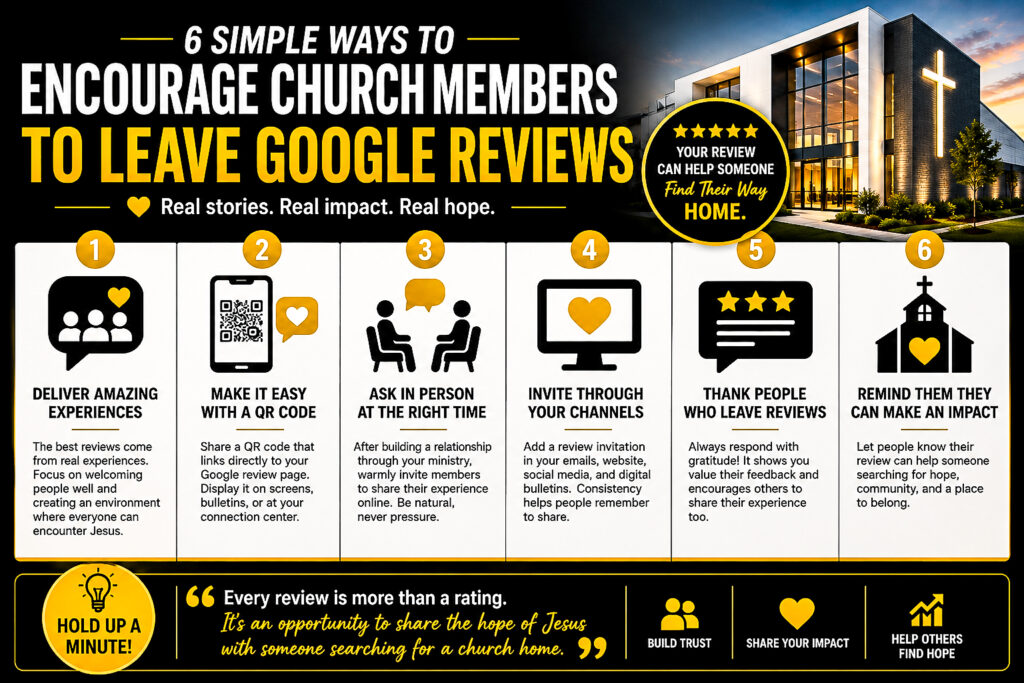
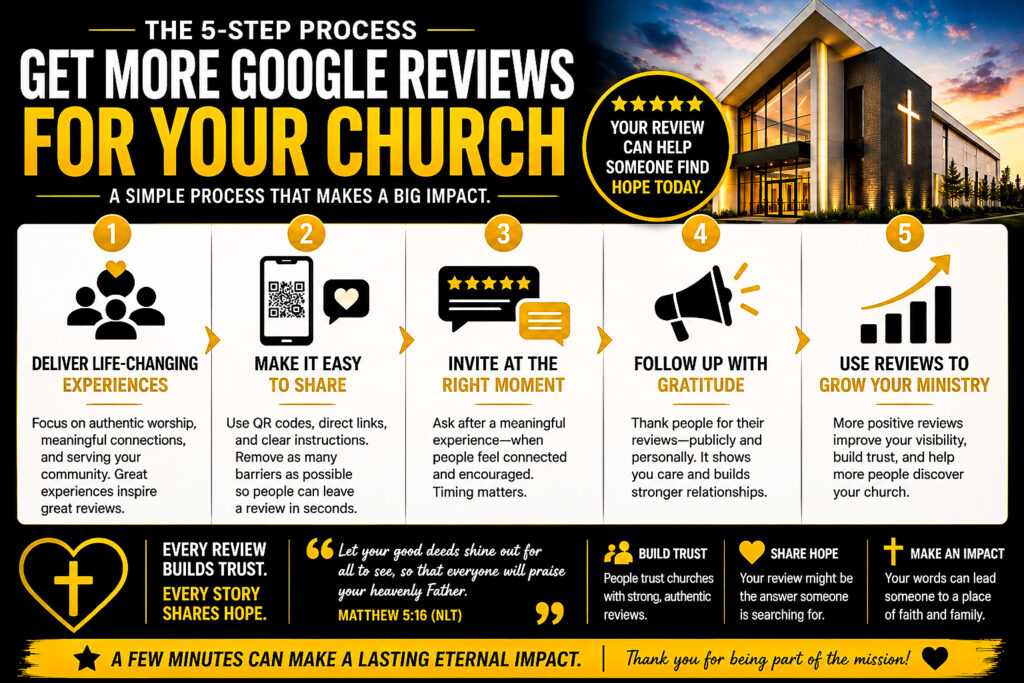
1. Ask After a Positive Experience
Timing matters.
If someone has just attended a special event, completed a newcomers class, participated in a baptism, or shared how much they enjoyed the service, that is often the perfect time to invite them to leave a review.
The experience is fresh in their mind, making it easier for them to describe what stood out.
2. Make It Easy
The easier you make the process, the more likely someone is to complete it.
Create a direct Google review link and place it where people can easily access it.
Need help creating the link? Follow our step-by-step guide on how to create a Google review link for your church.
Examples include:
- Your church website
- Your email newsletter
- A QR code in your lobby
- Your digital bulletin
- Follow-up emails for first-time guests
- Your Google Business Profile page
People are much more likely to leave a review if they can get there with one click.
3. Include Reviews in Your Follow-Up Process
If your church already follows up with first-time guests, consider adding a review request several days after their visit.
Give them enough time to reflect on their experience.
Your message might simply say:
Thank you for worshipping with us this past Sunday. If your visit was meaningful, would you consider sharing your experience with others by leaving an honest Google review? Your story may encourage someone searching for a church home.
This approach feels natural instead of promotional.
4. Use QR Codes Around Your Church
QR codes make leaving reviews incredibly convenient.
You can place them:
- At your welcome center
- Near the main exit
- Inside your café
- On visitor information cards
- On event signage
- At your information booth
Someone simply scans the code with their phone and is taken directly to your review page.
5. Mention Reviews Occasionally During Announcements
You don't need to make this a weekly announcement.
Instead, mention it naturally every few months.
For example:
If our church has impacted your life, one simple way you can help others find us is by sharing your honest experience through a Google review.
That simple invitation may inspire several people to participate.
6. Share the Link on Social Media
Your social media audience already knows your church.
Occasionally invite followers to share what God has done in their lives through your ministry.
Instead of saying, “Leave us a five-star review,” consider saying:
Has our church encouraged you or your family? We'd love for you to share your experience through an honest Google review. Your story may help someone looking for a church home.
This keeps the focus on ministry rather than marketing.
7. Thank Everyone Who Leaves a Review
When someone takes time to leave a review, acknowledge their effort.
A thoughtful response demonstrates appreciation and shows future visitors that your church values relationships.
Even a simple response such as:
Thank you for taking the time to share your experience. We are grateful you chose to worship with us, and we pray God continues to bless you and your family.
can leave a lasting impression.
When Should Your Church Ask for Google Reviews?
There isn't one perfect moment, but there are several natural opportunities.
Consider asking after:
- A first-time guest has returned.
- A successful outreach event.
- A baptism service.
- A marriage conference.
- A women's or men's conference.
- A youth event.
- A community outreach project.
- Someone shares a positive testimony.
The common thread is simple.
Ask when someone has experienced the ministry firsthand.
That leads to authentic, meaningful reviews rather than rushed responses.
What Should Churches Avoid?
Google wants reviews to reflect genuine experiences.
Churches should avoid any practice that attempts to manipulate the process.
Never:
- Pay people for reviews.
- Offer gifts in exchange for reviews.
- Create fake accounts.
- Ask staff members to post misleading reviews.
- Pressure people to leave only five-star ratings.
Instead, encourage honesty.
Some reviews may include suggestions for improvement, and that's okay.
Authentic feedback often builds greater credibility than a profile filled with identical five-star comments.
Remember, your goal is not simply to collect reviews.
Your goal is to faithfully represent your ministry while helping people discover a church where they can grow in their relationship with Christ.
How Should Churches Respond to Google Reviews?
Receiving reviews is only part of the process.
Responding to reviews demonstrates that your church values people, appreciates feedback, and takes the time to engage with its community.
Whether someone leaves a glowing review or shares a concern, every response is another opportunity to represent Christ with kindness, humility, and grace.
Hold up a minute! Your response is not only for the person who wrote the review. Future visitors will read your responses too. Every reply reflects your church's heart and culture.
How to Respond to Positive Reviews
Never copy and paste the exact same response to every review.
Instead, personalize your reply whenever possible.
Example:
Thank you for your kind words! We are grateful you chose to worship with us. It is our prayer that you continue growing in your relationship with Christ, and we look forward to seeing you again soon.
A thoughtful response lets people know their feedback was appreciated.
How to Respond to a Neutral Review
Sometimes someone leaves three or four stars without much explanation.
Rather than becoming defensive, simply thank them for visiting.
Example:
Thank you for visiting our church and taking the time to leave a review. We appreciate your feedback and hope to welcome you again soon. If there is anything we can do to serve you better, we'd love to hear from you.
How to Respond to a Negative Review
Every church eventually receives criticism.
While negative reviews can be discouraging, they also provide an opportunity to demonstrate humility and professionalism.
Before responding:
- Pray before writing.
- Read the review carefully.
- Avoid emotional responses.
- Do not argue publicly.
- Invite the conversation offline when appropriate.
Example:
Thank you for taking the time to share your experience. We are sorry to hear your visit did not meet your expectations. We genuinely value your feedback and would appreciate the opportunity to speak with you personally. Please contact our office so we can learn more and serve you better.
This type of response communicates compassion rather than conflict.
What About Fake Reviews?
Occasionally, churches receive reviews from people who have never attended or from spam accounts.
If that happens:
- Do not respond emotionally.
- Report the review through your Google Business Profile.
- Document any supporting information.
- Continue encouraging genuine members to leave honest reviews.
Over time, authentic reviews usually outweigh isolated false ones.
Google Review Best Practices for Churches
Healthy review growth happens naturally over time.
Instead of trying to collect dozens of reviews in one week, focus on building a consistent culture where members willingly share their experiences.
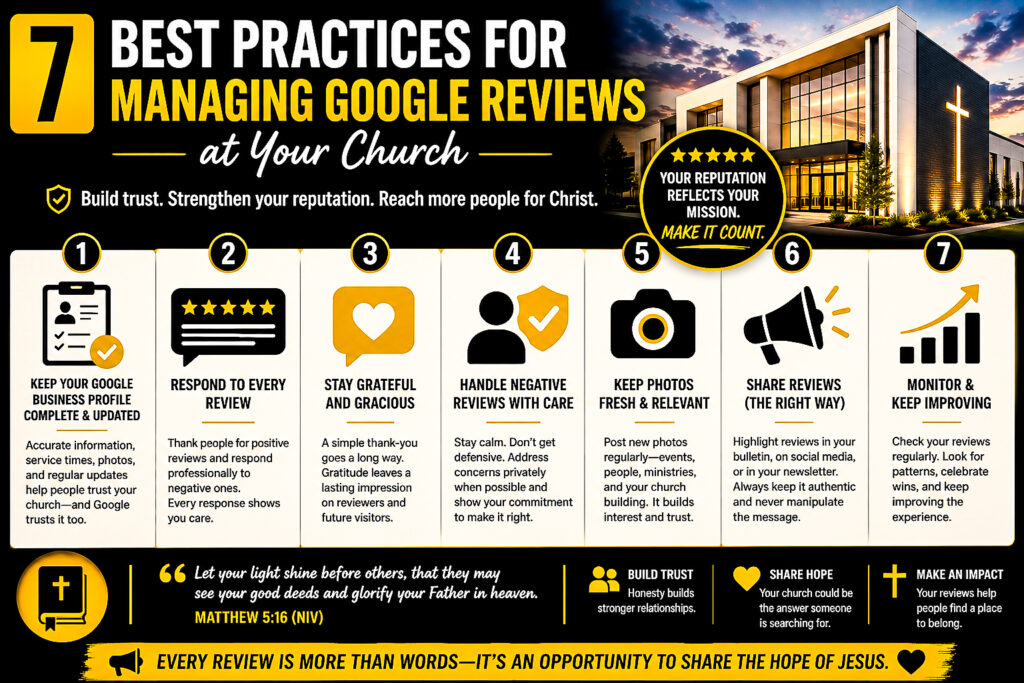
Here are several best practices:
- Keep your Google Business Profile updated.
- Respond to reviews regularly.
- Thank people for their feedback.
- Never purchase reviews.
- Never offer rewards for reviews.
- Encourage honesty rather than perfect ratings.
- Continue serving your community well.
- Ask consistently instead of only once a year.
Authenticity is always more valuable than volume.
How Google Reviews Can Support Church Growth
Google reviews alone will not grow a church.
Lives are changed through the Gospel, discipleship, prayer, and faithful ministry.
However, reviews can help remove uncertainty for people who are searching for a church home.
Someone reading several thoughtful reviews may decide to visit for the very first time because they feel more confident about what to expect.
In that sense, reviews become another way your church extends hospitality beyond its physical building.
Combined with a strong website, an optimized Google Business Profile, and helpful content, reviews become part of your church's overall digital outreach strategy.
If you'd like to strengthen your overall online presence, explore our guide to digital outreach for churches and learn how all of these pieces work together.
Remember
Google reviews are not about collecting stars.
They are about helping real people hear authentic stories from real people.
Your church's greatest testimony has always been transformed lives. Google reviews simply give those stories another place to be seen.
Frequently Asked Questions About Google Reviews for Churches
Do Google Reviews Help Churches Rank Higher on Google?
Google reviews are one of many signals Google considers when displaying local search results. While reviews alone will not guarantee higher rankings, an active Google Business Profile with honest reviews, complete information, and regular engagement can strengthen your church's local online presence.
Reviews work best when combined with:
- An optimized Google Business Profile
- A mobile-friendly church website
- Consistent church information across the web
- Helpful website content
- Good local SEO practices
How Many Google Reviews Should a Church Have?
There isn't a specific number.
Instead of focusing on quantity, focus on consistency.
A church that receives honest reviews throughout the year often builds more credibility than a church that suddenly receives dozens of reviews in a single weekend.
Your goal should be to make requesting reviews a natural part of your church's communication process.
Should Pastors Respond to Every Review?
Whenever possible, yes.
Responding shows appreciation, builds trust, and demonstrates that your church values people.
Even a short thank-you message lets visitors know their feedback matters.
Can Google Remove Fake Reviews?
Yes, Google allows businesses and organizations to report reviews that violate its policies.
However, not every negative review qualifies for removal.
If the review is legitimate, respond respectfully and professionally. If it is clearly fake or violates Google's guidelines, report it through your Google Business Profile.
Is It Okay for Churches to Ask for Reviews?
Absolutely.
There is nothing wrong with inviting people to share an honest experience.
The important thing is to avoid asking only for positive reviews or offering incentives in exchange for feedback.
Simply encourage people to tell their story honestly.
Make It Easy With a QR Code
One practical way to encourage reviews is to create a QR code that links directly to your church’s Google review page.
You can display the QR code on a welcome screen, visitor card, digital bulletin, or at your connection center. Some churches also invite first-time guests to a welcome room after service, where leaders can meet them, answer questions, and help them take their next step.
Hold up a minute! The goal is not to pressure a guest into leaving an immediate review. A better approach is to provide the QR code and invite people who have had enough time to experience the church to share their honest feedback.
You might say:
If your experience with our church has been meaningful, we would be grateful if you shared an honest Google review. Your story may help someone else who is searching for a church home.
Keeping the invitation optional, simple, and ministry-focused makes the process feel natural rather than promotional.
Final Thoughts
Every week, people search Google looking for hope, community, prayer, and a church where they can grow in their relationship with Jesus Christ.
Many of those people will discover your church online long before they ever walk through your front doors.
That is why your Google Business Profile deserves ongoing attention.
Accurate information, current photos, thoughtful responses, and authentic Google reviews all work together to create a welcoming first impression.
Hold up a minute! Google reviews are not about collecting stars. They are about sharing stories. Every honest review becomes another opportunity for someone searching online to discover a church where they can encounter Christ.
Remember, Google reviews are only one part of your church's digital outreach strategy.
When combined with a strong website, an optimized Google Business Profile, helpful blog content, and consistent local SEO, your church is in a much better position to reach people who are actively searching online.
Continue Learning
If you found this guide helpful, these resources will help you continue improving your church's online visibility:
- How to Set Up a Google Business Profile for Your Church
- Mobile Church Website Optimization for Churches
- Using Google Search Console for Church Website Insights
- Digital Outreach for Churches
- How to Improve Your Church's Visibility on Google
Free Resource
Want to know how visible your church is online?
Download our free Church Google Visibility Scorecard and evaluate your website, Google Business Profile, local SEO, and digital outreach in just a few minutes.
It's a practical resource designed to help pastors, church creatives, and ministry leaders identify simple improvements that can make a lasting impact.
Ready to Go Deeper?
If you'd like a complete, step-by-step system for helping your church get found on Google, explore our course, How Churches Get Found on Google.
The course walks through everything from SEO fundamentals and Google Search Console to Google Business Profiles, content strategy, and long-term church growth through search.
Whether you're a pastor, church media volunteer, or communications leader, you'll discover practical strategies you can begin implementing right away.