
Your church can have powerful worship, strong preaching, loving people, and a real heart for the community.
But if people cannot find your church online, they may never know you exist.
That is why church visibility on Google matters.
Today, many people look for a church before they ever walk into one. They search online first. They look for service times, directions, ministries, sermons, reviews, photos, and information about what to expect.
They may search phrases like:
- church near me
- churches in my area
- Sunday church service near me
- youth ministry near me
- Christian church near me
- church events near me
- how to find a church home
Hold up a minute! This is not just about getting more website traffic.
This is about helping real people find a place where they can hear the Gospel, experience community, receive prayer, and take their next step with Jesus.
Google has become one of the first places people turn when they are looking for help, hope, answers, community, and a church to visit.
That means your church website, Google Business Profile, blog content, Google Maps listing, YouTube videos, and online presence all matter.
Church visibility on Google is about making sure your church can be found when people are searching.
Not just by church members.
Not just by people who already know your name.
But by people in your city who are looking for a church, searching for answers, or trying to decide where to visit this Sunday.
What Does Church Visibility on Google Mean?
Church visibility on Google means your church shows up when people search for topics, questions, and local church-related needs online.
This can happen in different places.
Your church may show up in:
- Google Search results
- Google Maps
- Local search results
- Google Business Profile listings
- Blog articles
- YouTube videos
- Image results
- Featured snippets
- Search results for church-related questions
For example, if someone searches for “church near me,” your Google Business Profile may appear in Google Maps.
If someone searches “what should I expect when visiting a church,” your blog article may appear in Google Search.
If someone searches for your church name, your website, service times, address, reviews, and photos may appear.
If someone searches for a ministry topic your church has written about, one of your pages may show up.
That is visibility.
It means your church is not hidden online.
It means Google can understand your church, your content, your location, and the people you are trying to serve.
Visibility Is More Than Ranking for One Keyword
A lot of churches think Google visibility is only about ranking number one for one keyword.
But it is bigger than that.
Your church can be visible in many ways.
You may rank for your church name.
You may appear in Google Maps.
You may show up for local searches.
You may have blog articles getting impressions.
You may have YouTube videos appearing in search.
You may have ministry pages that answer specific questions.
You may have event pages that people discover through Google.
The goal is not just to rank for one phrase.
The goal is to build a stronger online presence so your church can be found in multiple ways.
That is why church visibility on Google matters so much.
When people search, your church should have a chance to show up.
Why Google Visibility Matters for Churches
For many people, Google is the new front door.
Before they visit your church building, they often visit your online presence first.
They may look at your website.
They may check your Google reviews.
They may look at your photos.
They may read about your ministries.
They may watch a sermon.
They may look for your address.
They may compare your church with others nearby.
That first online impression can shape whether they decide to visit.
If your church is hard to find, missing from Google Maps, has outdated information, or does not have helpful content, people may move on to another church that is easier to understand online.
That does not mean the other church has a better ministry.
It may simply mean they are easier to find.
People Are Searching Before They Visit
Many first-time guests do not start by calling the church office.
They start by searching.
They want to know:
- Where is the church located?
- What time does service start?
- What should I expect?
- Is there children’s ministry?
- What does the church believe?
- Are there ministries for my family?
- Can I watch a sermon first?
- Does this church seem welcoming?
If your church answers those questions clearly online, you remove barriers.
If your church does not answer those questions, people may feel uncertain.
Google visibility helps your church show up at the moment people are searching.
That is a ministry opportunity.
Visibility Helps People Find Hope
This is the heart of it.
Church visibility on Google is not about chasing algorithms.
It is about removing digital barriers.
Someone in your city may be searching because they are lonely.
Someone may be looking for a church after moving to a new area.
Someone may be searching for help for their family.
Someone may be looking for prayer.
Someone may be trying to come back to church after years away.
Someone may be searching because God is already drawing their heart.
If your church is visible, helpful, and easy to understand online, you create a clearer path for that person to connect.
That is why Google visibility is not just a marketing issue.
It is a ministry issue.
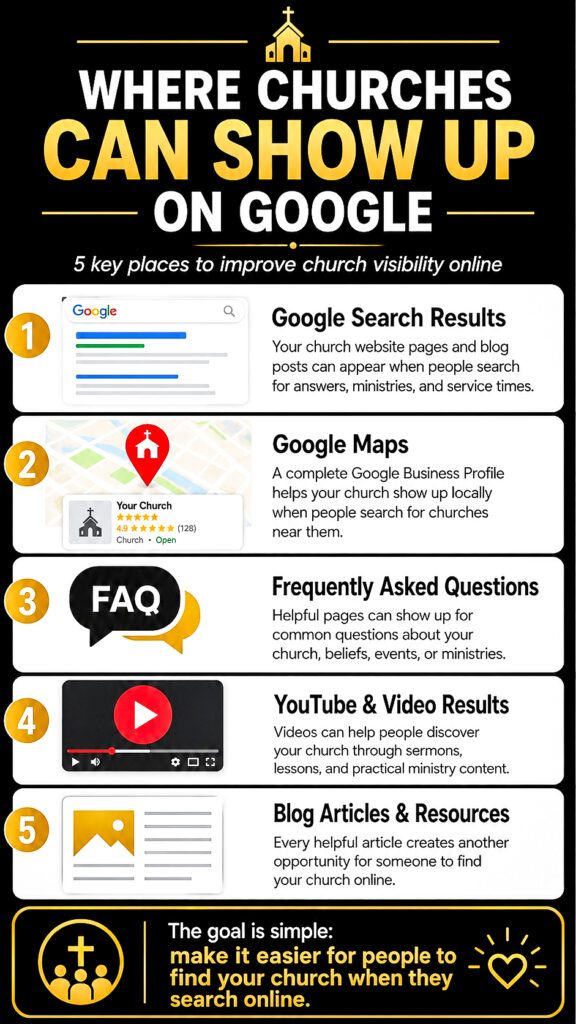
Where Churches Can Show Up on Google
When people think about showing up on Google, they usually think about the regular search results.
That is important, but it is only one part of the picture.
Your church can show up in several different places across Google.
The more complete your online presence becomes, the more opportunities people have to discover your church.
1. Google Search Results
Google Search results are the traditional listings people see when they type a question or phrase into Google.
This is where your church website, blog articles, ministry pages, event pages, and service information can appear.
For example, someone may search:
- what to expect when visiting a church
- churches with youth ministry near me
- how to get involved in church
- church events in my city
- how to grow spiritually
If your church has helpful content that answers those questions, Google may begin testing your pages in search results.
This is where church SEO becomes important.
Your website should help Google understand what your church offers, where you are located, who you serve, and what questions your content answers.
2. Google Maps
Google Maps is one of the most important places for local church visibility.
When someone searches for a church nearby, they often see map results before they ever visit a church website.
This is why your church’s Google Maps presence matters.
People may use Google Maps to find:
- Your address
- Directions
- Service times
- Phone number
- Photos
- Reviews
- Website link
- Distance from their location
If your church listing is incomplete, outdated, or hard to understand, people may keep scrolling.
But if your listing is clear, updated, and helpful, it can make it easier for someone to visit.
3. Google Business Profile
Your Google Business Profile is what helps your church appear in local results and Google Maps.
This profile can show your church name, address, phone number, website, photos, service times, reviews, and updates.
For many churches, the Google Business Profile is one of the most overlooked tools for local visibility.
It is also one of the most important.
A strong Google Business Profile helps people quickly answer basic questions:
- Where is the church?
- What time is service?
- Is the church active?
- What does the building look like?
- What do other people say about it?
- How do I contact them?
Hold up a minute! Your Google Business Profile may be the first impression someone has of your church before they ever click your website.
That means it should be accurate, updated, and welcoming.
4. Blog Articles
Blog articles help your church show up for questions people are asking.
This is one of the biggest missed opportunities for churches.
Many churches only use their website for basic information.
But a church blog can help answer real questions people are searching for online.
For example, a church could write articles such as:
- What should I expect when visiting church for the first time?
- How do I choose a church home?
- Why is prayer important?
- How can my family get involved in church?
- What does baptism mean?
- How can I grow spiritually?
These articles can help your church serve people before they ever attend.
Blog content also helps Google understand your church’s authority, topics, and ministry focus.
Every helpful article creates another opportunity for someone to find your church online.
5. YouTube Videos in Google Search
Google owns YouTube, and videos can appear in Google Search results.
That means your church’s sermons, short teachings, testimonies, event recaps, and ministry videos may have an opportunity to show up when people are searching.
This is especially helpful because some people would rather watch than read.
A video can help someone hear your pastor’s voice, see the heart of the church, and get a feel for the ministry before they visit.
Church videos can support Google visibility when they are titled clearly, described well, and connected back to your church website.
For example, a sermon video with a clear title and helpful description can reach people searching for that topic.
A short video about what to expect at your church can help first-time guests feel more comfortable.
A testimony video can help people connect emotionally with the mission of the church.
6. Image Results
Images can also help your church show up on Google.
Photos of your building, worship services, outreach events, youth ministry, children’s ministry, and community events can all support your online presence.
Image visibility matters because people often want to see what a church looks like before visiting.
They may want to know:
- What does the building look like?
- What is the atmosphere like?
- Are there families?
- Is there children’s ministry?
- Does the church look active?
- Does the church seem welcoming?
This is why image SEO matters.
When your church uploads images to the website, those images should have helpful file names, alt text, and descriptions when possible.
Instead of uploading an image named IMG_4827.jpg, use a descriptive file name that helps explain the image.
For example:
victory-outreach-san-francisco-sunday-service.jpg
That gives both visitors and search engines more context.
Your Church Needs More Than One Visibility Point
The strongest churches online do not depend on only one place to be found.
They build visibility across multiple points.
Your church website helps people learn.
Your Google Business Profile helps people find local information.
Google Maps helps people get directions.
Blog articles answer questions.
YouTube videos build trust.
Images help people see the life of the church.
Together, these pieces create a stronger Google presence.
And when your church becomes easier to find online, you create more opportunities for people to discover your ministry and take their next step toward Jesus.
How to Improve Your Church Visibility on Google
Improving your church visibility on Google does not happen by accident.
It happens when your church becomes more intentional about the way your website, Google Business Profile, content, and online presence work together.
The good news is your church does not need to do everything at once.
Start with the basics.
Then build from there.
1. Make Sure Your Church Website Is Clear
Your church website is one of the most important parts of your Google visibility.
When people click from Google to your website, they should quickly understand who you are, where you are, when you meet, and how they can take the next step.
A clear church website should include:
- Service times
- Location
- Contact information
- What to expect
- Ministry information
- Sermons or messages
- Plan Your Visit page
- Giving page
- Event information
- Clear calls to action
If your website is confusing, outdated, slow, or hard to use on a phone, people may leave before taking the next step.
That does not mean your church is not valuable.
It may simply mean your website is not making the path clear.
Hold up a minute! Your website should not make people work hard to find basic information.
If someone is thinking about visiting your church, make it easy for them.
2. Optimize Your Google Business Profile
Your Google Business Profile plays a major role in local church visibility.
This is especially important when people search for churches near them.
Your church should make sure the profile includes accurate and updated information, such as:
- Church name
- Address
- Phone number
- Website link
- Service times
- Photos
- Ministry updates
- Reviews
- Categories
- Description
If your Google Business Profile is incomplete, Google may have a harder time understanding your church.
Visitors may also have a harder time deciding whether to visit.
Keep your profile active.
Add new photos.
Post updates when possible.
Make sure service times are correct.
Respond to reviews with kindness and professionalism.
These small actions can make your church look active, welcoming, and trustworthy online.
3. Create Helpful Church Content
One of the best ways to increase church visibility on Google is to create helpful content that answers real questions.
This is where blog articles can become powerful.
Your church can write content that helps people understand faith, church life, family ministry, prayer, baptism, discipleship, outreach, and what to expect when visiting.
Examples of helpful church content include:
- What should I expect when visiting church for the first time?
- How do I choose the right church for my family?
- What does baptism mean?
- Why is prayer important?
- How can I grow closer to God?
- What is the purpose of church community?
- How can I get involved in ministry?
Every helpful article gives Google another page to understand, index, and potentially show to people searching online.
But the goal is not just to write random articles.
The goal is to create content that serves people and connects back to your church’s mission.
4. Use Keywords People Are Actually Searching For
Keyword research helps your church understand the words and questions people are using online.
This does not mean stuffing keywords into your website.
It means learning the language people use when they search.
For example, a church might use the phrase “discipleship pathway,” but someone in the community may search “how to grow spiritually.”
A church might say “children’s ministry,” but a parent may search “church with kids ministry near me.”
A church might say “outreach event,” but someone nearby may search “family events near me.”
When your church understands the phrases people are searching for, you can create content that connects with their actual questions.
That makes your website more helpful for both people and search engines.
5. Strengthen Your Local SEO
Local SEO helps your church show up for searches connected to your city, neighborhood, and surrounding area.
This matters because churches are local ministries.
People are usually not just looking for any church.
They are looking for a church they can actually visit.
To strengthen local SEO, make sure your church website includes:
- Your city and neighborhood
- Your address
- Service times
- Local ministry information
- Driving directions or map information
- Nearby community references when natural
- Location-specific pages or content when helpful
For example, instead of only saying “join us this Sunday,” your website can say something like:
“Join us this Sunday in San Francisco for worship, the Word, and community.”
That gives visitors more clarity and helps Google better understand your location.
6. Build Internal Links Between Related Pages
Internal links help connect your content together.
They also help visitors move from one helpful page to another.
For example, a blog article about visiting a church for the first time could link to your Plan Your Visit page.
A page about youth ministry could link to an article about helping teenagers grow in faith.
A blog about prayer could link to your prayer request page.
A church SEO article could link to your Google Search Console guide or church website analytics tools.
Internal links help Google understand your website structure.
They also help people keep exploring.
This is one of the simplest ways to improve your church website over time.
7. Review Your Data and Keep Improving
Church visibility on Google is not a one-time project.
It is something you improve over time.
Tools like Google Search Console and Google Analytics 4 can help you see what is happening.
Google Search Console can show:
- What keywords your pages are appearing for
- How many impressions your pages receive
- How many clicks your pages get
- Which pages Google is testing
- Whether your pages are being indexed
Google Analytics 4 can show:
- How people behave after visiting your website
- Which pages they view
- How long they stay
- Where visitors come from
- Whether people take important actions
Together, these tools help your church stop guessing and start improving.
You can see what Google is already testing.
You can see what visitors are doing.
Then you can update pages, improve titles, strengthen content, add internal links, and make next steps clearer.
That is how church visibility grows over time.
Common Mistakes That Keep Churches Hidden on Google
Many churches are not invisible online because they do not care.
They are invisible because they have never been taught how Google visibility works.
A church can love people, preach the Gospel, serve the community, and still be hard to find in Google Search.
Here are some common mistakes that keep churches hidden online.
1. The Website Only Talks to Current Members
Some church websites are built mainly for people who already attend.
They include announcements, giving links, service updates, and internal church language.
Those things matter.
But your website should also speak to new visitors.
Someone who has never attended your church may not understand your ministry names, your church culture, or your internal language.
They need clear answers.
They want to know:
- Where are you located?
- What time is service?
- What should I expect?
- Is there children’s ministry?
- What does your church believe?
- How do I contact someone?
- How do I plan a visit?
If your website only serves current members, it may miss the people who are searching for a church home.
2. Service Times and Location Are Hard to Find
This is one of the biggest mistakes churches make.
People should not have to search through multiple pages to find your service time or address.
That information should be easy to find on your homepage, contact page, footer, and Plan Your Visit page.
If someone is thinking about visiting this Sunday, do not make them work hard.
Make the next step clear.
A simple website can still be effective if the most important information is easy to find.
3. The Google Business Profile Is Outdated
Your Google Business Profile may be the first thing people see when they search for your church.
If the address is wrong, service times are missing, photos are old, or the website link is broken, it creates confusion.
An outdated Google Business Profile can make a church look inactive, even when the ministry is alive and moving.
Churches should review their profile regularly.
Check the basics.
Update photos.
Add service times.
Make sure the website link works.
Respond to reviews when appropriate.
Small updates can make a big difference.
4. The Church Website Has Little Helpful Content
A lot of church websites only have a few basic pages.
There is a homepage, about page, giving page, and maybe a sermon page.
That is a start, but it does not give Google much content to understand.
Helpful content gives your church more opportunities to show up in search.
If your church never writes blog articles, answers questions, explains ministries, or creates helpful pages, Google has fewer reasons to show your website for different searches.
Every helpful page creates another doorway.
Every article gives someone another way to discover your church.
5. The Website Does Not Use Local Language
Churches serve real communities.
That means your website should clearly mention your city, neighborhood, and local area when it is natural.
If your church is in San Francisco, your website should not only say “join us this Sunday.”
It can say:
“Join us this Sunday in San Francisco.”
If your church serves families in a specific area, say that clearly.
If your outreach serves a local neighborhood, include that information.
Local language helps people understand where you are.
It also helps Google understand the community your church serves.
6. Pages Are Not Connected With Internal Links
A church may have good pages on its website, but they are often disconnected.
A visitor reads one page and does not know where to go next.
Google also has a harder time understanding how the pages relate to each other.
Internal links help solve this.
A blog article about first-time visitors can link to the Plan Your Visit page.
A sermon page can link to a related Bible study resource.
A youth ministry page can link to an upcoming youth event.
A prayer article can link to a prayer request form.
Internal links help guide people.
They also help Google discover and understand your content.
7. Churches Publish Content but Never Review the Data
Publishing content is good.
But if you never review the data, you may miss what Google is already showing you.
Google Search Console can reveal which keywords your pages are appearing for.
Sometimes a page gets impressions but no clicks.
Sometimes Google is testing your content for a keyword you did not expect.
Sometimes an old article starts gaining attention and needs to be updated.
Hold up a minute! Before you rush to write another blog, check what Google is already testing.
You may not need to build a brand-new house.
You may need to renovate the one that is already getting attention.
That could mean improving the title, rewriting the intro, adding a stronger section, updating images, improving internal links, or making the next step clearer.
8. The Website Has No Clear Next Step
Visibility is important, but visibility alone is not enough.
Once people find your church online, they need to know what to do next.
Should they plan a visit?
Watch a sermon?
Contact the church?
Submit a prayer request?
Join an event?
Sign up for updates?
If your website does not guide people toward a clear next step, visitors may leave without responding.
Every important page should help people move forward.
The goal is not just to be seen.
The goal is to help people connect.
How Google Search Console Helps Churches Improve Visibility
One of the best tools for improving church visibility on Google is Google Search Console.
Google Search Console helps your church understand how your website is performing in Google Search.
It shows you what Google is already testing your website for.
That is important because many churches guess when they try to improve their website.
They guess what people are searching for.
They guess which pages matter.
They guess what content to write next.
They guess why people are not clicking.
Google Search Console helps remove some of that guessing.
It gives your church real search data.
Google Search Console Shows What People Are Searching
Google Search Console can show the search queries people used when your website appeared in Google.
These are called queries.
A query is simply the word or phrase someone typed into Google.
For example, your church website may appear for searches like:
- church near me
- church in your city
- youth ministry near me
- what to expect when visiting church
- Sunday service times
- prayer request
- how to grow spiritually
- church events near me
These queries are valuable because they show what people are already looking for.
They can also reveal opportunities you may not have noticed.
Sometimes Google starts testing your website for a keyword before you are intentionally targeting it.
That is a clue.
When you see those clues, you can make better decisions about what to improve next.
Google Search Console Shows Impressions and Clicks
Two of the most important numbers in Google Search Console are impressions and clicks.
An impression means your website appeared somewhere in Google Search.
A click means someone clicked through to your website.
Both numbers matter.
If a page is getting impressions, that means Google is showing it to people.
If a page is getting clicks, that means people are responding to what they see.
But sometimes a page gets impressions without many clicks.
That is where the opportunity is.
Hold up a minute! If Google is already showing your page, that page may not need to be ignored.
It may need to be improved.
Maybe the title is not strong enough.
Maybe the meta description is unclear.
Maybe the content needs a better opening.
Maybe the page needs a stronger answer.
Maybe the article needs updated images, internal links, or a clearer next step.
This is what I call renovating the house.
The page already exists.
Google is already testing it.
Now your job is to improve it so more people want to click and stay.
Google Search Console Helps Churches Find Hidden Opportunities
Some of the best church SEO opportunities are not found by guessing.
They are found by looking at what Google is already showing you.
For example, your church may have a page about first-time visitors.
When you open Google Search Console, you may notice that page is getting impressions for phrases like:
- what to expect at church
- first time visiting church
- church visitor guide
- what should I wear to church
- how to visit a church
That tells you something.
Google sees that page as connected to those topics.
Now you can improve the page by answering those questions more clearly.
You can add sections.
You can improve the title.
You can strengthen the introduction.
You can add internal links.
You can make the call to action clearer.
This is how churches can use data without becoming overly technical.
You are simply paying attention to what Google is already showing you.
Google Search Console Helps You Decide What to Write Next
Another benefit of Google Search Console is that it can help your church decide what content to create next.
Instead of asking, “What should we blog about?” you can ask:
“What is Google already testing us for?”
That question changes everything.
If you see impressions around children’s ministry, maybe your church should create more helpful content for families.
If you see impressions around prayer, maybe your church should create a prayer resource or prayer request page.
If you see impressions around baptism, maybe your church should write an article that explains baptism clearly.
If you see impressions around your city and church-related searches, maybe your local SEO needs to be strengthened.
The goal is not to chase every keyword.
The goal is to notice patterns.
Those patterns can show you where your church already has momentum.
Google Search Console Helps You Track Progress
Church visibility on Google takes time.
That is why tracking matters.
When your church updates a page, publishes new content, improves internal links, or strengthens SEO, Google Search Console can help you see whether things are moving in the right direction.
You can watch:
- Which pages are gaining impressions
- Which keywords are growing
- Which pages are getting clicks
- Which articles are being tested
- Which pages may need renovation
- Which topics are starting to build authority
This helps your church stay patient and strategic.
You do not need to panic if everything does not change overnight.
You can look for steady progress.
More impressions.
More clicks.
More relevant keywords.
Better pages.
Clearer next steps.
That is how church visibility grows over time.
Start With One Page
Your church does not need to analyze everything at once.
Start with one page.
Look at one article, one ministry page, or one important page on your website.
Ask simple questions:
- Is Google showing this page?
- What keywords is it appearing for?
- Are people clicking?
- Does the page answer the search clearly?
- Does the title make someone want to click?
- Is there a clear next step?
- Are there internal links to related pages?
That is enough to get started.
You do not have to become a data expert.
You just need to become more aware of the clues Google is already giving you.
When churches learn to use Google Search Console this way, they stop guessing and start improving with purpose.
If you want to better understand how Google Search Console helps churches see what people are searching for, watch this short lesson from the course.
How to Track Church Visibility Over Time
Once your church starts improving its Google visibility, the next step is tracking progress.
This matters because church visibility usually grows over time.
You may not see major changes overnight.
But if your church keeps improving the website, updating content, strengthening local SEO, and reviewing the right data, you can begin to see momentum.
The key is knowing what to watch.
You do not need to track every number.
Start with the numbers that help you understand whether more people are finding your church online.
Track Impressions in Google Search Console
Impressions show how often your website appears in Google Search.
This is one of the first signs that Google is starting to test your content.
If impressions are growing, that means your church is showing up more often.
That is important even before clicks increase.
For example, a church blog article may start with only a few impressions.
Then, over time, it may begin showing up for more search terms.
That tells you Google is beginning to understand the page.
When impressions grow, ask:
- What page is getting impressions?
- What keywords is Google showing it for?
- Is the page answering the search clearly?
- Does the title make people want to click?
- Is there a clear next step on the page?
Impressions are clues.
They show where Google may already be opening a door.
Track Clicks From Google Search
Clicks show how many people came to your website from Google Search.
If impressions are growing but clicks are not, that may mean the page needs improvement.
The title may not be strong enough.
The meta description may not be clear.
The search intent may not match the content.
The page may need a stronger introduction or more helpful sections.
This is where renovation matters.
Do not ignore a page just because it has low clicks.
If Google is giving that page impressions, it may already have potential.
Improve the page.
Make the title clearer.
Add helpful content.
Strengthen internal links.
Give visitors a better reason to click and stay.
Track Local Actions From Your Google Business Profile
For local church visibility, your Google Business Profile is important.
This is especially true when people search for churches near them or look for your church on Google Maps.
Your Google Business Profile can help you understand actions such as:
- Website clicks
- Direction requests
- Phone calls
- Profile views
- Searches for your church
- Photo views
- Local engagement
These actions matter because they show local interest.
Someone asking for directions may be thinking about visiting.
Someone clicking your website may want to learn more.
Someone calling may have a question before attending.
These are not just numbers.
They represent people taking steps toward your church.
Track Website Behavior in Google Analytics 4
Google Analytics 4 helps you understand what people do after they arrive on your website.
Google Search Console shows how people find you.
Google Analytics 4 shows what they do next.
This matters because visibility is only the beginning.
Once people visit your site, you want to know whether they are engaging.
In GA4, your church can look at things like:
- Which pages people visit
- How long they stay
- Where they came from
- Which pages they leave from
- Whether they click important buttons
- Whether they visit your Plan Your Visit page
- Whether they submit a form or take another next step
This helps your church understand whether the website is serving visitors well.
If people are finding your church but leaving quickly, the page may need to be improved.
If people are visiting your Plan Your Visit page, that may be a strong sign of interest.
If people are reading blog articles but not clicking to other pages, you may need better internal links and clearer calls to action.
Track Your Most Important Pages
Not every page needs the same level of attention.
Start with your most important pages.
These may include:
- Homepage
- Plan Your Visit page
- About page
- Contact page
- Sermon page
- Children’s ministry page
- Youth ministry page
- Giving page
- Events page
- Top blog articles
These pages should be clear, helpful, and easy to navigate.
If one of these pages starts getting search impressions, pay attention.
If one of these pages gets traffic but no one takes action, review it.
If one of these pages is outdated, update it.
Your most important pages should not sit untouched for years.
They should be reviewed and improved over time.
Create a Simple Visibility Tracking Routine
Your church does not need a complicated dashboard to start tracking visibility.
A simple monthly routine can work.
Once a month, review:
- Top Google Search Console queries
- Top pages getting impressions
- Pages getting impressions but low clicks
- Google Business Profile actions
- GA4 top pages
- Plan Your Visit clicks
- Contact form activity
- Important pages that need updates
Then choose one or two improvements.
That is the key.
Do not just look at the data.
Use the data to take action.
You may update a title.
You may improve a page.
You may add an internal link.
You may upload new photos to your Google Business Profile.
You may write a new article based on a keyword Google is already testing.
You may add a clearer call to action.
Small improvements made consistently can build stronger church visibility over time.
Church Visibility Is Built Through Consistency
Your church does not become more visible on Google by doing one thing one time.
Visibility grows through consistent improvement.
Clear website pages.
Updated Google Business Profile information.
Helpful content.
Strong local SEO.
Internal links.
Better titles.
Good images.
Regular tracking.
When those pieces work together, your church becomes easier to find, easier to understand, and easier to visit.
That is the goal.
Not just more traffic.
More clarity.
More connection.
More opportunities for people to find your church and take a step toward Jesus.
Frequently Asked Questions About Church Visibility on Google
How do I improve church visibility on Google?
You can improve church visibility on Google by making sure your church website is clear, your Google Business Profile is updated, your content answers real questions, and your local SEO is strong.
Start with the basics.
Make sure your website has accurate service times, address, contact information, ministry pages, and a clear Plan Your Visit page.
Then make sure your Google Business Profile includes your church name, address, phone number, website link, service times, photos, reviews, and helpful updates.
After that, begin creating helpful content that answers the questions people are searching for online.
Church visibility improves when Google can understand who your church serves, where you are located, what your ministry offers, and how your content helps people.
How do I make my church more visible online?
To make your church more visible online, focus on building a stronger digital presence across your website, Google Business Profile, Google Maps, blog content, YouTube videos, and social media.
Your church website should be the main hub.
Your Google Business Profile should help people find your location.
Your blog articles should answer helpful questions.
Your videos should build trust.
Your social media should point people toward next steps.
The goal is not to be everywhere just to be busy.
A clear digital outreach strategy helps your church connect your website, content, social media, and next steps together.
The goal is to make it easier for people to discover your church, understand your ministry, and take the next step.
What is church visibility on Google?
Church visibility on Google means your church can be found when people search for church-related topics, local ministries, service times, directions, or questions online.
This can include showing up in Google Search, Google Maps, local search results, Google Business Profile listings, blog articles, YouTube videos, and image results.
It is not just about ranking for one keyword.
It is about building an online presence that helps Google understand your church and helps people find your ministry.
When your church is visible on Google, people have more opportunities to discover who you are, where you are, and how they can connect.
Why is church visibility on Google important?
Church visibility on Google is important because many people search online before visiting a church.
They want to know where the church is located, what time service starts, what the church believes, whether there is children’s ministry, what the atmosphere is like, and how to take the next step.
If your church is hard to find online, people may never make it to your building.
Google visibility helps remove digital barriers.
It gives your church more opportunities to reach people who are searching for hope, community, prayer, answers, and a place to worship.
How do I get my church to show up on Google Maps?
To help your church show up on Google Maps, you need to claim, verify, and optimize your Google Business Profile.
Make sure your profile includes accurate information, including your church name, address, phone number, website, service times, description, categories, photos, and updates.
You should also encourage genuine reviews from people connected to your church and respond to reviews when appropriate.
Google Maps visibility is especially important for local searches like “church near me” or “churches in my area.”
The clearer and more complete your profile is, the easier it becomes for people to find your church locally.
How do I optimize Google Business Profile for my church?
You can optimize your Google Business Profile by keeping it accurate, active, and helpful.
Make sure your church name, address, phone number, website, and service times are correct.
Add quality photos of your building, worship services, ministries, and outreach events.
Write a clear description that explains who your church serves and what people can expect.
Choose the most accurate categories.
Post updates when possible.
Respond to reviews with kindness.
Your Google Business Profile should help someone quickly understand your church and feel more confident about visiting.
What are the best practices for church SEO?
Some of the best practices for church SEO include using clear page titles, writing helpful content, adding local information, improving website speed, making your site mobile-friendly, using internal links, optimizing images, and tracking performance in Google Search Console.
Church SEO should not feel complicated.
At the basic level, it is about helping Google understand your church website and helping people find useful information.
Start by improving the pages that matter most, such as your homepage, Plan Your Visit page, ministry pages, contact page, and key blog articles.
Can I use social media to boost church visibility?
Yes, social media can help support church visibility, but it should not replace your website or Google presence.
Social media is helpful for engagement, announcements, clips, testimonies, events, and community connection.
But your website gives your church a long-term home online.
Google Search can continue sending people to your content over time.
The best approach is to let social media and your website work together.
Use social media to build awareness and point people back to helpful pages, sermon content, event pages, blog articles, and next steps on your church website.
Final Thoughts: Church Visibility Helps People Find Hope
Church visibility on Google is not just about rankings.
It is not just about clicks.
It is not just about traffic.
At the heart of it, church visibility is about helping people find hope.
Your church may have the answer someone is praying for.
Your church may have a community someone needs.
Your church may have a ministry that can help a family.
Your church may have a message that points someone back to Jesus.
But if people cannot find your church online, they may never know that help is available.
That is why your church website, Google Business Profile, Google Maps listing, blog content, videos, images, and search visibility all matter.
They are not just digital tools.
They are connection points.
They help people discover your church before they ever walk through the doors.
Start With One Step
You do not have to fix everything at once.
Start with one step.
Update your Google Business Profile.
Improve your homepage.
Create a Plan Your Visit page.
Write one helpful blog article.
Review your Google Search Console data.
Add internal links between related pages.
Upload better photos.
Make your service times easier to find.
Small improvements made consistently can make your church easier to find, easier to understand, and easier to visit.
Hold up a minute! This is not about making your church look bigger than it is.
It is about making your church easier to find for the people God may already be drawing.
Visibility Creates Opportunity
When your church becomes more visible on Google, more people have the opportunity to discover your ministry.
Someone searching for a church near them may find your Google Maps listing.
Someone looking for answers may find your blog.
Someone nervous about visiting may watch a sermon.
Someone checking your church for the first time may read your Plan Your Visit page.
Someone looking for help may submit a prayer request.
That is the power of visibility.
It creates more opportunities for people to move from searching to connecting.
And when your online presence is clear, helpful, and intentional, it can support the mission of your church in a powerful way.
Use Google as a Ministry Opportunity
Google is not just a search engine.
For churches, it can become a ministry opportunity.
Every search represents a person.
Every impression is a chance to be seen.
Every click is a potential connection.
Every helpful page can serve someone before they ever attend.
That is why churches should take Google visibility seriously.
Not because we are trying to chase trends.
Not because we are trying to impress people.
But because people are searching.
And when people are searching, your church should be easier to find.
If you want to know where your church stands right now, start by reviewing your website, your Google Business Profile, your Google Search Console data, and your most important pages.
Look for the gaps.
Look for the clues.
Look for the pages Google is already testing.
Then start improving one step at a time.
Because when your church becomes more visible online, you create more opportunities for people to discover your ministry, visit your church, and take their next step toward Jesus.