
What should a church website include on the homepage?
At a minimum, your church homepage should help visitors understand who you are, when you meet, where you are located, what they can expect, and what they should do next.
Your homepage is often the first place a new visitor encounters your ministry.
Before they walk through your doors, meet a greeter, hear the worship team, or listen to the pastor preach, they may spend several minutes looking through your church website.
They are quietly asking questions such as:
- Is this church welcoming?
- What time does the service begin?
- Where is the church located?
- What should I expect when I arrive?
- Is there something for my children?
- Will I feel comfortable attending?
A strong church homepage answers those questions quickly and clearly.
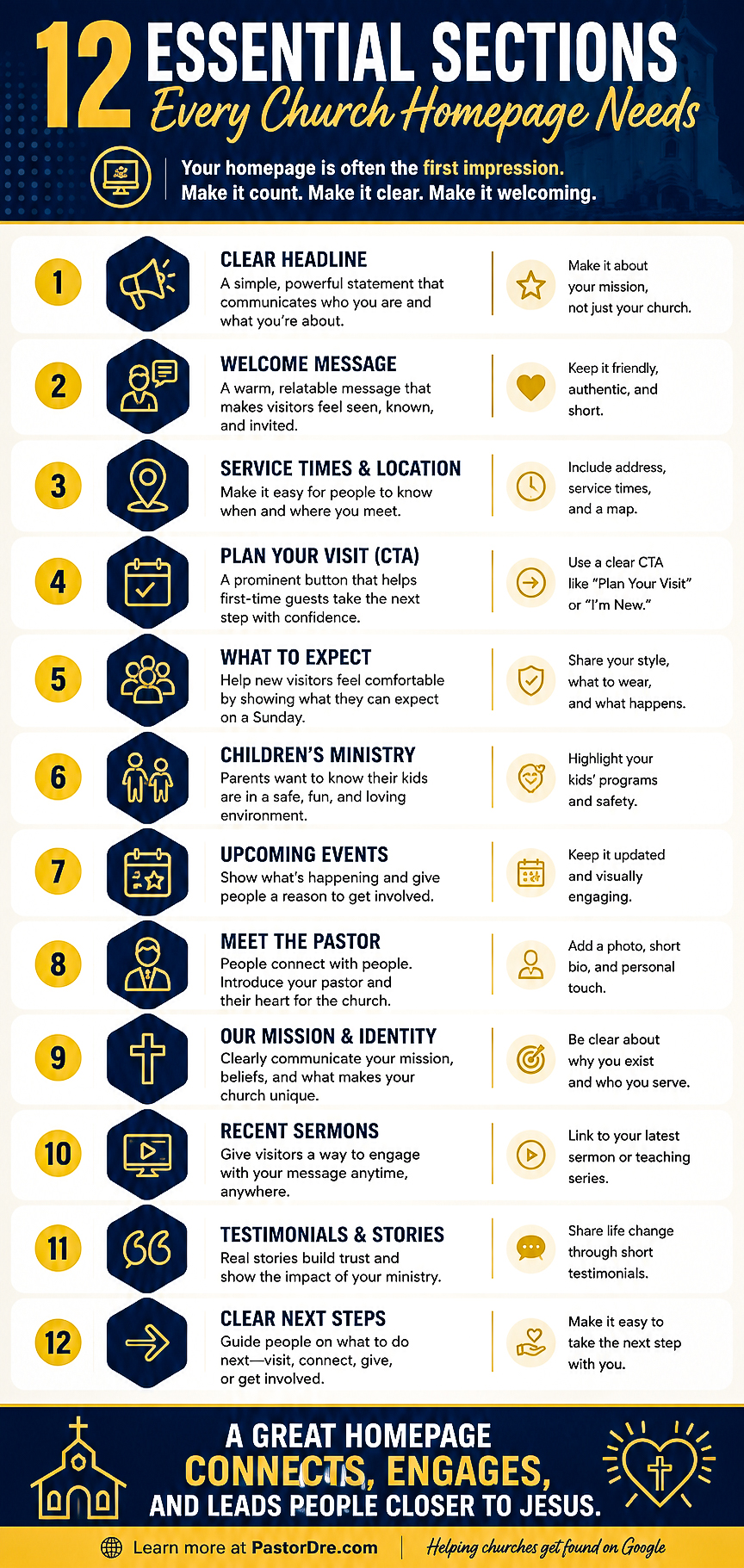
In this guide, we will look at 12 must-have elements for a church homepage. You do not have to place these sections in one exact order, but the information should be easy for first-time visitors to find.
If your church is creating a website for the first time or planning a complete redesign, you may also want to read our simple guide to building a church website .
What Should a Church Website Include on the Homepage?
- A clear homepage headline
- A welcoming message
- Service times and location
- A Plan Your Visit button
- A What to Expect section
- Children’s ministry information
- Upcoming events
- A brief pastor introduction
- The church’s mission and identity
- Recent sermons or messages
- Testimonials and transformation stories
- Clear next steps
What Is the Purpose of a Church Website Homepage?
The purpose of a church website homepage is to introduce your ministry, answer a visitor’s most important questions, and guide people toward a meaningful next step.
Your homepage should not try to tell the complete story of every ministry, event, department, and leader.
Instead, it should serve as a clear starting point.
A visitor should be able to quickly understand:
- Who your church is
- Who your church is trying to reach
- When and where you meet
- What the worship experience is like
- Whether their family will feel welcome
- How they can plan their first visit
Beautiful design can support that purpose, but appearance alone is not enough. Our guide to what makes the best church website design effective explains why clarity and visitor experience should come before visual effects.
Before we walk through each section in detail, here is a quick visual overview of the 12 essential elements every church homepage should include.
1. A Clear Headline That Explains Who You Are
The first section of your homepage is often called the hero section. It usually includes a large headline, a short supporting statement, an image or video, and one or two buttons.
This section should immediately help visitors understand what kind of church they have found.
Avoid using a headline that sounds inspirational but does not provide enough clarity.
For example, a phrase such as “Welcome Home” may feel warm, but it does not tell a new visitor much about the church.
You can still use an inspiring phrase, but support it with a sentence that explains who you are and how your church helps people.
Example Church Homepage Headline
A Place to Belong, Grow, and Discover God’s Purpose for Your Life
Join us this Sunday for passionate worship, practical Bible teaching, and a welcoming community for the entire family.
Buttons: Plan Your Visit | Watch Online
Your headline should speak to the people you are trying to reach while remaining true to your church’s identity.
2. A Welcoming Message for First-Time Visitors
One of the essential features for a church homepage is a short welcome message that helps visitors feel seen, valued, and invited.
Many church websites focus heavily on the church itself—its history, ministries, vision, and accomplishments.
Those things are important, but a new visitor is also wondering whether there is a place for them.
A strong church welcome message speaks directly to the visitor.
Example Church Welcome Message
Whether you are exploring faith for the first time, returning to church after being away, or looking for a church family, we would be honored to welcome you.
Come as you are and discover a community where you can grow in faith, build meaningful relationships, and take your next step with God.
You do not need to write a long letter. A few sincere sentences can communicate warmth and help visitors feel more comfortable.
3. Service Times and Location
Service times and location should be among the easiest pieces of information to find on your church homepage.
Do not assume visitors will search through the menu, visit the contact page, or scroll to the footer to find out when your church meets.
Include the following information directly on the homepage:
- The day of the service
- The exact starting time
- The church’s physical address
- A link to directions or a map
- Parking information when necessary
- Livestream information if online services are available
Example Service Information
Join Us This Sunday
Sunday Worship Experience
10:30 AM
123 Main Street
San Francisco, California
Free parking is available in the lot behind the church.
4. A Strong “Plan Your Visit” Button
One of the most valuable calls-to-action on a church website homepage is a button that says:
Plan Your Visit
This button should lead to a page that gives first-time guests everything they need to feel prepared before attending.
A Plan Your Visit page may include:
- Service times
- Directions
- Parking instructions
- What people normally wear
- What the service is like
- Children’s check-in information
- Accessibility information
- A short welcome video
- A form visitors can complete before arriving
The goal is not to collect as much information as possible. The goal is to remove uncertainty.
Other helpful homepage buttons might include:
- Watch Online
- Get Directions
- View Upcoming Events
- Learn About Our Church
Avoid placing six or seven competing buttons in the opening section. Give first-time visitors one clear primary action.
5. A “What to Expect” Section
Visiting a new church can feel intimidating.
Even people who have attended church for years may feel nervous when walking into an unfamiliar building.
They may wonder where to park, where to sit, how long the service will last, and whether anyone will notice that they are new.
A simple What to Expect section can remove many of those concerns.
Example “What to Expect” Copy
When you arrive, our welcome team will be available to help you find your way. Our Sunday service usually lasts about 75 minutes and includes worship, prayer, and a practical message from the Bible.
You are welcome to dress comfortably and come as you are.
Be honest about the experience. Do not try to make your church sound like another ministry. Help visitors understand what your church is genuinely like.
You might explain:
- How long the service usually lasts
- The style of worship
- Whether there is a children’s program
- What people typically wear
- Whether guests will be asked to introduce themselves
- What happens after the service
6. Children’s Ministry Information
Parents are not only evaluating whether they will enjoy the church.
They are also deciding whether their children will be safe, welcomed, and spiritually cared for.
Your homepage should briefly communicate that children are valued and that a safe process is in place.
Include information such as:
- The ages served by the children’s ministry
- When children’s services are available
- Where families should check in
- Whether volunteers are screened
- How parents will be contacted if needed
- Whether nursery care is available
Example Children’s Ministry Section
Your Children Will Be Welcomed and Cared For
Our children’s ministry provides a safe, fun, and faith-filled environment for children from nursery through fifth grade.
Our trained team will help your family through the check-in process when you arrive.
The homepage does not need to explain every ministry policy. Provide enough information to build confidence, then link to a complete children’s ministry page.
7. Upcoming Church Events
Upcoming events show visitors that your church is active and provide additional ways for people to get connected.
However, avoid turning the homepage into a crowded announcement board.
Feature two or three of the most important upcoming events and provide a button that leads to the complete church calendar.
Each featured event should include:
- A clear event title
- The date and time
- A short description
- A relevant image
- A registration or information button
For important events, create a dedicated page instead of sending people only to a flyer or social media post. Our guide on how to create a church event landing page explains how to give visitors the information they need and guide them toward registration.
8. A Brief Introduction to the Pastor
People often want to know who will be teaching, leading, and caring for the church community.
Include a brief introduction to the lead pastor or pastoral team.
This section should feel warm and personal rather than reading like a formal résumé.
Example Pastor Introduction
Meet Pastors James and Lisa
Pastors James and Lisa have a heart to help people discover hope, grow in their relationship with God, and make a difference in their community.
They would love the opportunity to welcome you and your family this Sunday.
Include a friendly, high-quality photograph and link to a longer About page for visitors who want to learn more.
Keep this homepage section focused on connection. A visitor usually does not need to read the pastor’s complete ministry history before deciding whether to attend.
9. Your Church’s Mission and Identity
Visitors should be able to understand what your church values and what kind of community you are building.
Your mission statement should help answer questions such as:
- Why does this church exist?
- Who is the church called to reach?
- How does the church help people grow?
- What makes the ministry distinctive?
Avoid filling the homepage with internal language that only longtime members understand.
For example, instead of writing only:
“We exist to fulfill our five-fold kingdom mandate.”
You could explain the mission in visitor-friendly language:
We exist to help people encounter God, grow in faith, build meaningful relationships, and use their gifts to make a difference.
Your theology does not need to be watered down. It simply needs to be communicated clearly.
10. Recent Sermons or Messages
Recent sermons allow people to experience the teaching ministry before attending in person.
Feature one recent message or a small selection of sermons on the homepage.
Include a clear title, thumbnail, speaker’s name, and link to watch or listen.
This section can help visitors answer important questions:
- What kind of teaching can I expect?
- Is the message understandable and practical?
- Does the church teach from the Bible?
- Does the pastor communicate in a way I connect with?
Sermons can also become the foundation for a wider content strategy. Our weekly content plan for churches shows how one Sunday message can become videos, short clips, social posts, emails, and blog content.
Avoid embedding too many videos on the homepage because they may slow down the page. Feature a small number and link to the full sermon library.
11. Testimonials and Stories of Transformation
Church websites often explain what the ministry believes and what programs it offers, but stories show how the ministry is affecting real lives.
A short testimony can help visitors imagine what God could do in their own lives.
Example Church Testimonial
“When my family first visited, we immediately felt welcomed. Through the church, we found community, grew in our faith, and discovered a place where our children could thrive.”
Testimonials may come from:
- New members
- Families
- Young adults
- People who found recovery or restoration
- Community outreach participants
- Ministry volunteers
Always ask for permission before publishing someone’s story, photograph, or personal information.
These stories do not have to be dramatic. A sincere account of finding community, returning to faith, or feeling welcomed can be powerful.
12. Clear Next Steps for Website Visitors
Every effective church homepage should help visitors decide what to do next.
Do not assume people will naturally explore the rest of the website. Give them a clear path.
Helpful next steps may include:
- Plan your first visit
- Watch the latest message
- Submit a prayer request
- Join a small group
- Register for an event
- Learn about baptism
- Meet the pastor
- Volunteer with a ministry
- Contact the church
The homepage should not give every next step equal visual importance.
Choose one primary action for first-time visitors and then provide a few secondary options.
Best Practices for Church Homepage Design
The information on your homepage matters, but the way that information is organized also affects whether visitors will stay and explore.
Keep the Main Message Clear
Visitors should understand who you are and what you are inviting them to do within the first few seconds.
Use Real Images of Your Church
Whenever possible, use current photographs of your congregation, worship services, children’s ministry, outreach, and leadership.
Real images help visitors understand what your church community actually looks like.
Design for Mobile Visitors
Many people will first visit your church website from a phone.
Make sure the text is easy to read, buttons are easy to tap, images display correctly, and important information is not hidden.
Use Clear Section Headings
Most website visitors scan before reading closely. Descriptive headings help them quickly find the information they need.
Limit Competing Calls-to-Action
Too many buttons can create confusion. Decide which action is most important for each section.
Keep the Homepage Updated
Review service times, event dates, staff information, links, images, and announcements regularly.
How to Improve Church Website Engagement
Church website engagement improves when visitors can quickly find helpful information and are given clear reasons to take action.
Here are several practical ways to make a church website more engaging:
- Use a welcoming headline that speaks directly to visitors
- Add a short welcome video from the pastor
- Feature a clear Plan Your Visit button
- Include real stories from people in the church
- Make prayer requests easy to submit
- Feature one or two current events
- Provide a simple way to watch the latest sermon
- Use clear images and short sections instead of long blocks of text
- Make sure the website loads quickly on mobile devices
Why Is a Church Homepage Important for Outreach?
A church homepage is important for outreach because people often research a church online before deciding whether to visit in person.
Someone may discover your church through Google, social media, a friend, a flyer, a YouTube video, or a community event.
In many cases, their next step will be visiting your website.
A clear homepage can help them:
- Understand your ministry
- Find your location
- Confirm service times
- Learn about programs for their family
- Watch a message
- Plan their first visit
A confusing or outdated homepage may cause someone to leave without taking another step.
Your homepage is only one part of that larger system. Explore these practical digital outreach strategies for churches to learn how your website, Google presence, content, email, video, and social media can work together.
Should a Church Homepage Link to a Blog?
Yes. If your church publishes useful articles, the homepage can feature a small number of recent or important resources.
A church blog can answer questions people in your community are already asking about faith, family, recovery, prayer, purpose, relationships, and local ministry opportunities.
Those articles create additional ways for people to discover your church through Google. Once they arrive, internal links can guide them toward sermons, ministries, events, prayer, or a first visit.
You do not need to display ten articles on the homepage. Feature two or three helpful resources and link to the complete blog.
What Should You Remove From a Church Homepage?
Improving a homepage is not only about adding more sections.
Sometimes the most effective improvement is removing content that creates confusion.
Too Many Competing Buttons
When every button is treated as equally important, visitors may not know where to click. Highlight one primary action in each major section.
Outdated Announcements
Old events, expired registration links, and outdated service information can damage trust.
Review the homepage regularly and remove anything that is no longer current.
Large Blocks of Text
Most visitors scan a webpage before deciding whether to read it closely.
Break long paragraphs into shorter sections with helpful headings.
Internal Church Language
Avoid unexplained ministry names, abbreviations, and phrases that a first-time guest may not understand.
Low-Quality or Outdated Images
Use real, current photographs of your church whenever possible.
Images should reflect the people, atmosphere, and community of the ministry today.
Automatic Music or Video
Media that begins playing automatically can surprise visitors and may cause them to leave the website.
Allow people to choose when they want to watch or listen.
Too Many Homepage Sections
Your homepage does not have to contain every piece of information about the church.
Its purpose is to create clarity and guide visitors to the appropriate page.
Effective Church Homepage Layout Ideas
There is no single homepage layout that every church must follow, but the sections should flow in a logical order.
Here is one effective church homepage layout:
- Headline, supporting message, and Plan Your Visit button
- Service times and location
- Short church welcome message
- What to Expect section
- Children’s ministry information
- Upcoming events
- Church mission and values
- Pastor introduction
- Recent sermon
- Testimonial or transformation story
- Final Plan Your Visit call-to-action
This order begins with the information a visitor needs immediately and then introduces deeper information about the church.
Church Website Homepage Checklist
Use this checklist to review your church homepage:
- Does the opening headline clearly communicate who we are?
- Is there a welcoming message for first-time visitors?
- Are the service time and location easy to find?
- Is there a clear Plan Your Visit button?
- Do we explain what visitors can expect?
- Is children’s ministry information easy to access?
- Are upcoming events current and relevant?
- Is there a friendly introduction to the pastor?
- Can visitors understand our mission?
- Can people watch or listen to a recent sermon?
- Do we include real stories or testimonials?
- Is there an obvious next step?
- Does the homepage work well on mobile devices?
- Do all buttons and links work correctly?
- Does the page load quickly?
Frequently Asked Questions About Church Website Homepages
What should a church website include on the homepage?
A church website homepage should include a clear headline, welcome message, service times, location, Plan Your Visit button, What to Expect information, children’s ministry details, upcoming events, pastor introduction, church mission, recent sermons, testimonials, and clear next steps.
What are the essential features for a church homepage?
The most essential features are service times, location, a clear description of the church, information for first-time guests, a Plan Your Visit button, and an obvious next step.
How long should a church homepage be?
A church homepage should be long enough to answer a visitor’s most important questions without becoming overwhelming.
There is no perfect word count. Prioritize clarity, helpful sections, and easy navigation.
Should service times appear at the top of the homepage?
Yes. Service times should appear near the top of the homepage or be immediately accessible through a prominent button.
Visitors should not have to search for them.
Should a church homepage include the pastor’s biography?
Include a brief and welcoming introduction on the homepage, then link to a separate About page for the pastor’s complete biography.
Should upcoming events be placed on the homepage?
Yes, but feature only the most relevant upcoming events.
Link to a complete events page rather than placing the entire calendar on the homepage.
Does a church website need a Plan Your Visit page?
A Plan Your Visit page is highly recommended because it gathers the information first-time guests need in one place and reduces uncertainty before they attend.
Should a church homepage include blog posts?
A church homepage can feature two or three recent or important blog posts. This helps visitors discover useful resources without allowing the blog section to overwhelm the main purpose of the homepage.
How often should a church homepage be updated?
Review it at least once a month and anytime service times, leadership information, events, or major ministry details change.
Expired announcements should be removed immediately.
Your Church Homepage Should Help People Take Their Next Step
Your church homepage does not need to be flashy, complicated, or filled with the latest design effects.
It needs to be clear.
It should help visitors understand who you are, when you meet, where you are located, what they can expect, and how they can take their next step.
Remember that the person visiting your website may be looking for hope, community, prayer, healing, or a place where their family can grow.
Do not make them dig through your website to find an invitation.
Start with the must-have elements in this guide, improve one section at a time, and make it easier for people in your community to discover your church and feel confident about visiting.
Not Sure What Your Church Homepage Is Missing?
Request a church website review and receive practical recommendations to help make your website clearer, more welcoming, and easier for visitors to use.
Request a Church Website Review