
When pastors and church leaders search for the best church website design, they are usually looking for more than a nice-looking website.
They want to know what works.
They want to know what makes a church website clear, helpful, modern, mobile-friendly, and easy for visitors to use.
They may be comparing church website examples.
They may be looking at the best church website templates for 2026.
They may be trying to figure out how to build a church website.
They may be wondering what features a church website should include.
They may even be asking how much church website design costs.
But here is the key:
The best church website design is not just about how a website looks.
It is about how well the website serves people.
A strong church website should help people find your church, understand your ministry, and take a clear next step.
It should answer the questions people are already asking before they visit.
It should work well on mobile devices.
It should help your church show up on Google.
It should make service times, location, ministries, sermons, and next steps easy to find.
Hold up a minute.
A beautiful church website that confuses people is not effective.
The best church website design combines beauty, clarity, strategy, and purpose.
What Is Church Website Design?
Church website design is the process of creating or improving a church website so it clearly communicates who the church is, what it offers, and how people can connect.
Church website design includes things like:
- Page layout
- Colors and branding
- Fonts and readability
- Photos and visuals
- Mobile design
- Navigation
- Homepage structure
- Service time placement
- Ministry pages
- Sermon pages
- Giving pages
- Contact forms
- Visitor next steps
- SEO-friendly structure
But strong church website design is not only visual.
It is strategic.
A church website should be designed around the people who will use it.
That includes first-time visitors, current members, families, people looking for prayer, people watching sermons, people searching on Google, and people trying to decide if your church is a place where they can belong.
Why Church Website Design Matters
Church website design matters because your website is often one of the first places people go before they visit your church.
Someone may see your church on Google.
Someone may hear about your church from a friend.
Someone may watch a sermon clip.
Someone may see a social media post.
Someone may search for churches near them.
But before they show up, many people will visit your website.
They want answers.
They want clarity.
They want to know what to expect.
They want to know if the church feels welcoming.
They want to know if there is something for their family.
They want to know where to go, when to arrive, and how to take the next step.
That means your church website is not just a design project.
It is a digital front door.
And if that front door is confusing, outdated, or hard to use, some people may never take the next step.
The Best Church Website Design Starts With Clarity
The best church website design starts with clarity.
Before people care about the design style, they need to understand the basics.
A visitor should quickly know:
- Who your church is
- Where your church is located
- When your church meets
- What they can expect
- How to plan a visit
- What ministries are available
- How to watch a sermon
- How to contact someone
- What step to take next
If your website looks modern but hides the most important information, the design is not doing its job.
Clarity is one of the most important parts of church website design.
A clear website reduces confusion.
It builds trust.
It helps people feel more comfortable before they ever walk through the doors.
Top Church Website Features Every Church Should Include
When people search for top church website features, they are usually trying to understand what a strong church website should actually include.
A church website does not need every feature available.
It needs the right features.
The best church website design should include features that help people find information quickly and take action.
Here are some of the most important features:
- Clear service times
- Location and directions
- What to expect page
- Plan your visit page
- Ministry pages
- Sermon or media page
- Events page
- Giving page
- Prayer request or contact form
- Mobile-friendly design
- SEO-friendly structure
- Clear calls to action
- Simple navigation
These features help your website serve both visitors and current members.
The goal is not to overload the website.
The goal is to make the website useful.
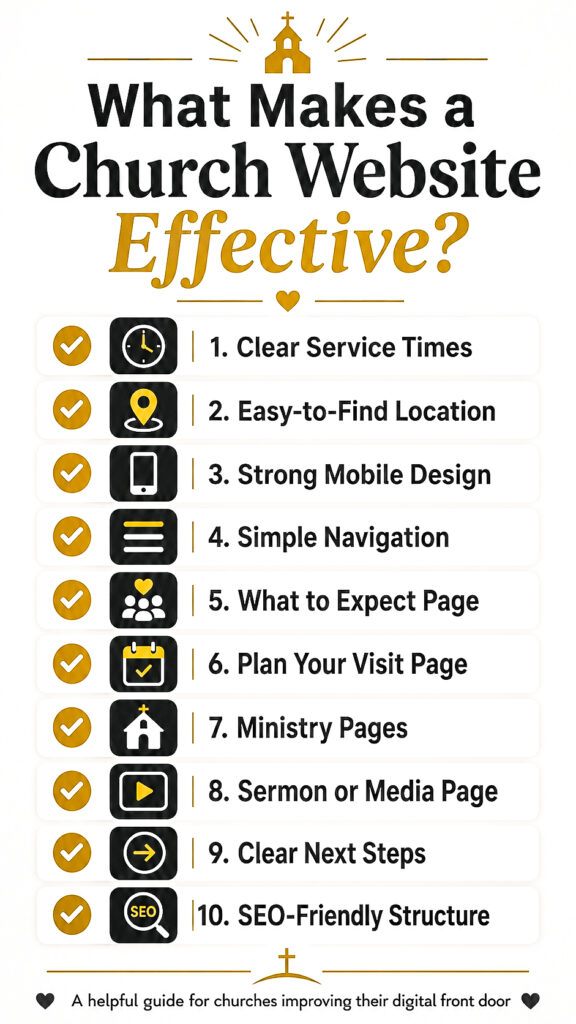
What Makes a Church Website Effective?
An effective church website helps people move from curiosity to connection.
It does not just give information.
It guides people.
A strong church website should do several things well.
1. It Makes Service Times Easy to Find
Service times should be one of the easiest things to find on your church website.
Do not make people search for them.
Do not hide them in a paragraph.
Do not only place them on an events page.
Your service times should be visible on the homepage, the footer, the visit page, and any page where a first-time visitor may be looking for basic information.
If someone has to click around too much to find out when your church meets, that is a challenge.
Simple is better.
2. It Clearly Shows the Location
Your church location should be clear and easy to understand.
Include your full address, city, state, and a map if possible.
If your church meets in a rented facility, school, community center, or shared space, explain that clearly.
If parking is confusing, give simple instructions.
If there are multiple entrances, tell people which one to use.
Location clarity matters because most church visits are local.
People are not just looking for inspiration.
They are asking, “Can I actually get there?”
3. It Has a Strong “What to Expect” Page
A “What to Expect” page is one of the best pages a church website can have.
This page helps first-time visitors feel more comfortable before attending.
It can answer questions like:
What time should I arrive?
How long is the service?
What is worship like?
What should I wear?
Is there children’s ministry?
Will someone greet me?
Can I come if I have never been to church before?
A good “What to Expect” page removes uncertainty.
It helps people feel welcomed before they arrive.
4. It Includes a Clear “Plan Your Visit” Page
A “Plan Your Visit” page gives interested visitors a clear next step.
This page should be simple and focused.
It can include:
- Service times
- Location
- Parking details
- Children’s ministry information
- A short welcome message
- A simple form
- Contact information
- What to expect
The goal is to help someone move from “I am interested” to “I know what to do next.”
The best church website design makes that next step obvious.
5. It Works Well on Mobile Devices
Church website design for mobile devices is one of the most important parts of a modern church website.
Mobile design is not optional.
Many people will visit your church website from their phone.
If the website is hard to read, slow to load, or difficult to navigate on mobile, visitors may leave.
A mobile-friendly church website should have:
- Easy-to-read text
- Clear buttons
- Simple menus
- Fast loading pages
- Clickable phone numbers
- Easy directions
- Short forms
- Visible service times
- Clear next steps
Your website may look great on a desktop computer, but the mobile experience is what many visitors will see first.
6. It Uses Real, Welcoming Photos
Photos matter.
The best church website design uses images that help people understand the heart of the church.
Real photos of your church, worship, families, leaders, volunteers, outreach, and community can build trust.
People want to see what your church feels like.
Stock photos can be useful in some cases, but real photos are usually stronger because they show authenticity.
Use photos that are clear, warm, welcoming, and ministry-focused.
Avoid photos that feel too staged, too dark, too blurry, or disconnected from your actual church.
7. It Has Simple Navigation
Your website navigation should be easy to understand.
Visitors should not feel lost.
A simple church website menu may include:
- Home
- About
- Visit
- Ministries
- Sermons
- Events
- Give
- Contact
The exact menu may vary, but the goal is the same.
Make it easy for people to find what matters.
If the navigation has too many options, visitors may feel overwhelmed.
A strong design simplifies the path.
8. It Helps People Understand Your Ministries
Ministry pages help people see where they can connect.
Your church website should explain ministries clearly.
This may include:
- Kids ministry
- Youth ministry
- Young adults
- Small groups
- Men’s ministry
- Women’s ministry
- Outreach
- Recovery ministry
- Prayer ministry
- Discipleship
Each ministry page should answer:
Who is this ministry for?
When does it meet?
What can someone expect?
How can someone get involved?
Who should they contact?
Clear ministry pages help visitors and members find their place.
9. It Includes Sermons or Media
A sermon or media page helps people experience your church before they attend.
Someone may watch a sermon before deciding to visit.
Your sermon page does not have to be complicated.
It just needs to be organized and easy to use.
You can include:
- Recent sermons
- YouTube videos
- Message series
- Audio messages
- Speaker information
- Notes or descriptions
- Related next steps
This also helps current members stay connected during the week.
10. It Is Built With SEO in Mind
The best church website design should also consider SEO.
A website can look beautiful, but if people cannot find it, the design has limited reach.
Church website SEO helps your church show up when people search online.
An SEO-friendly church website should include:
- Clear page titles
- Helpful headings
- Local keywords
- Optimized images
- Fast loading pages
- Mobile-friendly design
- Internal links
- Service times
- Location information
- Google Search Console setup
- Google Analytics 4 setup
- Helpful content
Your website should be designed for people first, but it should also help Google understand your church, your location, and your ministry.
If you want to understand why your church website needs more than good design, watch this short lesson on why SEO matters for churches.
Best Church Website Templates 2026: Should Your Church Use One?
Many pastors search for the best church website templates in 2026 because templates can be a fast and affordable way to build or redesign a church website.
A church website template can be helpful if your church needs a simple starting point.
Templates can save time because the layout is already created.
They can also help churches with smaller budgets get online faster.
But a template is only helpful if it supports your church’s goals.
A good church website template should include:
- A clear homepage layout
- Service time sections
- Location and map areas
- A visit page
- Ministry page layouts
- Sermon or media sections
- Event sections
- Giving page options
- Mobile-friendly design
- SEO-friendly structure
The challenge with templates is that many churches use them without customizing the message.
A template may look good, but your church still needs clear wording, real photos, accurate service times, strong next steps, and local SEO.
A template can give you the structure.
But your church still needs the strategy.
Church Website Design Trends 2026
Church website design trends in 2026 are not just about looking modern.
The strongest trends are about clarity, mobile experience, and helping visitors take action.
Some important church website design trends include:
- Simple homepage layouts
- Strong mobile-first design
- Clear visitor pathways
- Shorter forms
- Real church photography
- Sermon video integration
- Fast-loading pages
- Clear calls to action
- Local SEO content
- Helpful blog content
- Clean typography
- Easy navigation
Trends can be helpful, but churches should not follow trends just because they look nice.
The best trend is clarity.
If a design trend helps people understand your church and take the next step, it may be worth using.
If it makes the website harder to use, skip it.
Affordable Church Website Builders: Are They Enough?
Affordable church website builders can be a good option for churches with smaller budgets.
Tools like website builders, templates, and drag-and-drop platforms can help a church get online without paying for a full custom website.
This can be helpful when:
- Your church has a limited budget
- You need a simple website quickly
- You have someone who can update the site
- You only need basic pages
- You are willing to learn the platform
But affordable website builders also have limits.
Your church still needs clear messaging, SEO-friendly pages, mobile-friendly design, strong calls to action, and regular updates.
The tool does not replace the strategy.
A church website builder can help you create the site.
But your church still needs to know what the site should say and how it should guide people.
How Much Does Church Website Design Cost?
Church website design cost can vary depending on what your church needs.
A simple church website may cost much less than a full custom website with strategy, SEO, copywriting, sermon integration, online giving, event systems, and ongoing support.
The cost can depend on things like:
- Number of pages
- Custom design needs
- Website platform
- Copywriting
- SEO setup
- Mobile optimization
- Sermon or video integration
- Online giving setup
- Forms and automation
- Ongoing maintenance
- Training for your team
Before comparing prices, compare what is included.
A cheaper website may look affordable at first, but it may not include SEO, mobile optimization, strategy, analytics, or training.
A more expensive website may cost more upfront, but it may include deeper strategy and support.
The better question is not only, “How much does it cost?”
The better question is, “Will this website help our church communicate clearly, show up online, and help people take the next step?”
Church Website Design Cost Comparison: What Should You Compare?
When doing a church website design cost comparison, do not only compare the final price.
Compare the value.
Ask what each option includes.
Compare:
- Design quality
- Mobile optimization
- SEO setup
- Page structure
- Copywriting
- Google Search Console setup
- Google Analytics 4 setup
- Training
- Support
- Website maintenance
- Ability to update the site
- Visitor next steps
- Ministry page setup
- Blog or content strategy
A low-cost website may be fine for a smaller church that needs a simple online presence.
A larger church or growing ministry may need a more strategic website that supports outreach, content, events, giving, and visitor follow-up.
The right investment depends on your church’s goals, budget, and team capacity.
Can You Use Free Tools to Design a Church Website?
Yes, churches can use free tools to design a website, especially when the budget is limited.
Free tools can help you start.
They may be useful for:
- Basic website pages
- Simple landing pages
- Graphics
- Planning content
- Writing website copy
- Organizing ministry information
- Creating forms
- Sharing sermons or videos
But free tools also have limits.
They may not give you the best design, speed, SEO structure, domain setup, analytics, or long-term flexibility.
If your church uses free tools, keep the website simple and clear.
Make sure people can find service times, location, what to expect, sermons, contact information, and next steps.
A free tool can help you begin.
But clarity is still the goal.
Best Church Website Design Is Not Just About Looks
Many churches think the best church website design is about looking modern.
Modern design matters.
But looks are only one part of the website.
A church website can look good and still fail to help visitors.
A strong design should answer real questions.
It should make next steps clear.
It should work on mobile.
It should help with Google visibility.
It should make the church feel welcoming.
It should support ministry goals.
A good-looking website may impress people for a moment.
A clear and helpful website can move people toward connection.
That is the difference.
Top Church Website Examples: What to Look For
When looking at top church website examples, do not only look at the visual style.
Look at how the website functions.
Ask questions like:
Can I find service times quickly?
Is the location easy to find?
Is there a clear visitor page?
Is the website mobile-friendly?
Does the homepage explain the church clearly?
Are ministry pages easy to understand?
Can I watch a sermon?
Is there a clear next step?
Does the site feel welcoming?
Does the website load quickly?
Can Google understand the site structure?
The best examples are not always the flashiest.
The best examples are the ones that help people take action.
User-Friendly Church Website Examples: What They Have in Common
User-friendly church website examples usually have a few things in common.
They are easy to understand.
They are not overloaded with too many choices.
They make important information easy to find.
They work well on mobile.
They guide people toward simple next steps.
A user-friendly church website usually includes:
- Clear homepage message
- Easy menu
- Service times near the top
- Location information
- Visit page
- Simple ministry pages
- Sermons or media
- Contact options
- Fast loading speed
- Mobile-friendly layout
User-friendly does not mean boring.
It means people can use the website without confusion.
Common Church Website Design Mistakes
Here are some common church website design mistakes to avoid.
1. Hiding Service Times
Service times should be easy to find.
If visitors cannot quickly find when your church meets, they may leave.
2. Using Too Much Church Language
Church language can confuse people who are new to faith or new to your ministry.
Use clear language that visitors can understand.
3. Making the Homepage Too Busy
A homepage should not try to say everything.
It should guide people to the most important next steps.
4. Forgetting Mobile Users
A website that only works well on desktop is missing a major part of the audience.
Mobile design should be a priority.
5. Not Having a Clear Next Step
Every church website should help people know what to do next.
Plan a visit.
Watch a sermon.
Request prayer.
Contact the church.
Join a group.
The next step should be clear.
6. Ignoring Google Visibility
A website that is not built with search in mind may be harder to find.
SEO should be part of the design conversation from the beginning.
7. Not Updating the Website
An outdated website can create confusion.
Make sure your service times, events, ministries, photos, and contact information stay current.
How to Improve Your Church Website Design
If your church website needs improvement, you do not always have to rebuild everything immediately.
Sometimes small changes can make a big difference.
Start with these steps:
- Make service times easy to find
- Add or improve your “What to Expect” page
- Create a clear “Plan Your Visit” page
- Update your homepage message
- Improve mobile navigation
- Add real church photos
- Simplify your menu
- Update ministry pages
- Add sermon videos
- Optimize page titles and descriptions
- Connect your website to Google Search Console
- Track visitor behavior with Google Analytics 4
The goal is progress.
Your website does not have to be perfect to become more helpful.
Church Website Design and Digital Outreach
Church website design is part of digital outreach.
Your website supports what your church is already doing in the community.
When someone hears about your church, sees a post, watches a video, or finds you on Google, your website becomes the place where they learn more.
That means your website should connect with your larger outreach strategy.
Your website should support:
- Google visibility
- Local SEO
- Social media
- Sermon clips
- Email updates
- Event promotion
- Visitor follow-up
- Ministry connection
- Prayer requests
- Online giving
When your website works with your outreach efforts, your church becomes easier to find and easier to connect with.
Frequently Asked Questions About Best Church Website Design
What is the best church website design?
The best church website design is clear, mobile-friendly, easy to navigate, and focused on helping people take the next step.
It should include service times, location, visitor information, ministry pages, sermons, giving, contact options, and SEO-friendly structure.
How do I design a church website in 2026?
To design a church website in 2026, start with clarity.
Make sure your website has service times, location, a what to expect page, a plan your visit page, ministry pages, sermons, giving, contact forms, mobile-friendly design, and SEO-friendly structure.
Then make sure the website is easy to update and connected to tools like Google Search Console and Google Analytics 4.
What are the best practices for church websites?
The best practices for church websites include clear navigation, visible service times, mobile-friendly design, fast-loading pages, real photos, simple next steps, strong visitor pages, ministry pages, sermon content, SEO-friendly structure, and updated information.
How do I make my church website more engaging?
You can make your church website more engaging by using real photos, helpful videos, sermon clips, testimonies, ministry highlights, clear calls to action, and simple visitor pathways.
Engaging does not mean complicated.
It means people can quickly understand your church and know how to connect.
Why is mobile optimization important for church websites?
Mobile optimization is important because many people visit church websites from their phones.
They may be looking for service times, directions, sermons, or what to expect.
If your website is hard to use on mobile, visitors may leave before taking the next step.
What is the average cost of church website design?
The average cost of church website design depends on the size of the website, the number of pages, the platform, design needs, SEO setup, copywriting, mobile optimization, and ongoing support.
Instead of only comparing price, compare what is included and whether the website will help your church communicate clearly and reach people online.
When should I update my church website design?
You should update your church website design when the site feels outdated, service times are hard to find, mobile experience is poor, navigation is confusing, pages are no longer accurate, or visitors are not taking clear next steps.
You should also update your site if your church is growing, changing ministries, or trying to improve Google visibility.
Where can I find church website templates?
You can find church website templates through website builders, church website platforms, WordPress themes, and design marketplaces.
Before choosing a template, make sure it supports service times, location, visitor pages, ministry pages, sermons, giving, mobile design, and SEO-friendly structure.
Can I use free tools to design my church website?
Yes, you can use free tools to design a church website, especially if your church has a limited budget.
But free tools still need a clear strategy.
Make sure your website is easy to use, mobile-friendly, clear, and focused on helping people take the next step.
What are the must-have features for a church website?
Must-have features for a church website include service times, location, what to expect page, plan your visit page, ministry pages, sermon page, giving page, contact form, prayer request option, mobile-friendly design, and SEO-friendly structure.
What are common church website design mistakes?
Common mistakes include hiding service times, using confusing language, having too many menu options, ignoring mobile design, not having clear next steps, using outdated information, and forgetting about Google visibility.
Final Thoughts: The Best Church Website Design Serves People
The best church website design is not just about having a modern look.
It is about serving people well.
Your website should help people find your church.
It should help visitors understand what to expect.
It should make service times and location easy to find.
It should support families, ministries, sermons, giving, prayer, and next steps.
It should work well on mobile.
It should help your church show up on Google.
And most of all, it should help people move from searching to connecting.
A strong church website is clear, helpful, welcoming, and built with purpose.
It does not just sit online.
It serves as a digital front door for your church.
And when that digital front door is clear, welcoming, and easy to use, more people have the opportunity to take their next step.