
Long before someone walks through your church doors, they may visit your website looking for answers. They want to know what your church is like, when services begin, where to park, what their children will experience, and whether they will feel comfortable attending.
That is why every church website should have a clear and welcoming church welcome page, often called a New Here page. This page is designed specifically for first-time visitors, newcomers, and people who are quietly considering attending your church.
Hold up a minute! A church welcome page should not pressure someone into planning a visit before they feel ready. Its first responsibility is to welcome them, answer their questions, remove uncertainty, and help them become familiar with your ministry.
Think about what happens when a new person enters your church building. A friendly greeter welcomes them, answers their questions, helps them find their way, and shows them where to go next. Your New Here page should provide that same warm experience online.
A church welcome page should help people feel informed, welcomed, and comfortable enough to consider taking their next step.
This page is also different from a Plan Your Visit page. Your welcome page provides helpful information without requiring a commitment. Your Plan Your Visit page serves people who are ready to take action, select a service, ask questions, or let your church know they are coming.
In this guide, we will walk through 12 important sections your church welcome page should include. These ideas will help your website serve first-time visitors with clarity, warmth, and genuine ministry.
If you have not created the next step in your visitor journey yet, read our guide on how to create a Plan Your Visit experience for your church .
What Is a Church Welcome Page?
A church welcome page is a dedicated page on your website created to serve first-time visitors and people who are learning about your ministry. Many churches label this page New Here, Start Here, First Time?, or Welcome.
Unlike a church homepage, which must communicate with members, visitors, families, ministry partners, and the surrounding community, a welcome page has one primary audience: the person considering your church for the first time.
Hold up a minute! That person may not be ready to complete a form, speak with a pastor, or announce that they are coming. They may simply want to quietly explore your church and decide whether it feels like a place where they could belong.
A well-designed New Here page gives visitors the freedom to learn at their own pace. It answers the practical questions that can create uncertainty, including:
- What time does the service begin?
- Where is the church located?
- Where should I park and enter the building?
- What normally happens during the service?
- What should I wear?
- Is there a safe and welcoming ministry for my children?
- Will someone help me when I arrive?
These questions may appear simple to someone who attends church regularly, but they can feel significant to a first-time visitor. Every clear answer removes another barrier that might prevent someone from attending.
The Digital Front Door of Your Church
Your church welcome page can become the digital front door of your ministry. It allows people to look inside, understand what to expect, and become familiar with your church before they ever visit in person.
Consider a family that recently moved into your community, a person returning to church after many years, or someone who has never attended a church service. They may visit several church websites before deciding where to go.
A confusing or incomplete website may leave them with more questions. A warm, informative church welcome page can communicate:
You are welcome here. We have thought about your first experience, and we want to help you feel prepared.
Welcome First, Invitation Second
The goal of this page is not to pressure every visitor into making an immediate decision. Its first purpose is to provide clarity, build trust, and create a sense of welcome.
Once visitors receive the information they need, we can offer a simple next step. They might watch a welcome video, explore the church’s beliefs, learn about children’s ministry, complete a digital welcome card, or visit the Plan Your Visit page.
Let’s think of the journey this way: your church welcome page helps people become comfortable, while your Plan Your Visit page helps interested visitors prepare to attend.
1. Begin With a Warm Welcome Message
The first thing visitors should experience on your church welcome page is a sincere and encouraging welcome. Before presenting schedules, directions, programs, or forms, take a moment to speak directly to the person visiting your website.
Your welcome message does not need to be long. A few thoughtful sentences can reassure visitors that they are welcome regardless of their background, previous church experience, or current stage of faith.
Hold up a minute! Avoid making the opening sound like an advertisement. This is ministry before marketing. The visitor should feel as though a friendly church leader is speaking directly to them.
Example Church Welcome Message
Welcome! We are glad you are here.
Whether you are searching for a church home, returning to church after some time away, or simply exploring faith, we want you to know that you are welcome.
Take a few moments to learn about our church, what you can expect during a service, and how we can help make your first visit comfortable.
Use language that sounds like your actual church. If your ministry is energetic and expressive, allow that warmth to come through. If your church has a more traditional atmosphere, communicate with warmth while remaining true to your identity.
For additional examples, visit our guide on how to write a church welcome message for your website .
2. Include a Short Welcome Video
A short video from the pastor or another familiar ministry leader can make your New Here page feel more personal. Visitors get to see a friendly face, hear the heart behind the ministry, and begin forming a connection before attending.
The video does not need an expensive production. Good lighting, clear sound, a clean background, and a sincere message are more important than elaborate equipment.
Keep the video between one and two minutes whenever possible. The pastor can briefly:
- Welcome the visitor personally.
- Share the heart and mission of the church.
- Acknowledge that visiting a new church can feel unfamiliar.
- Explain what visitors can discover on the page.
- Invite them to attend whenever they feel ready.
Sample Pastor Welcome Video Script
“Hello, and thank you for taking a moment to learn more about our church. We understand that visiting a church for the first time can bring questions, so we created this page to help you know what to expect. Take your time, look around, and if you decide to join us for a service, we would be honored to welcome you.”
Place the video near the top of the page, but do not make it play automatically with sound. Give visitors the choice to press play when they are ready.
3. Give Visitors a Brief Introduction to Your Church
After welcoming the visitor, provide a short introduction explaining who your church is. This is not the place for the entire history of the ministry. Focus on the information that helps a newcomer understand your church’s identity and heart.
Your introduction might briefly mention:
- The type of community your church serves
- Your mission or ministry focus
- The atmosphere visitors can expect
- The importance of faith, family, discipleship, and community
- What makes your ministry experience distinctive
For example:
We are a diverse and welcoming church family committed to helping people know Jesus, grow in faith, and discover their God-given purpose. Our services include uplifting worship, practical biblical teaching, prayer, and ministry for the entire family.
Let’s keep this introduction focused on the visitor. Instead of only explaining what the church has accomplished, show newcomers what they may experience and how the ministry can support their spiritual journey.
Consider including one authentic photograph of your congregation worshiping, connecting, or serving together. Real pictures help visitors see the people and atmosphere behind the words.
Quick takeaway: The opening of your church welcome page should answer three emotional questions: Am I welcome? Who are these people? Could I see myself attending this church?
4. Clearly Display Service Times and Location
One of the most important responsibilities of your church welcome page is to help visitors quickly find your service times and location. Do not make someone search through several pages to discover when or where your church meets.
Display this information near the top half of the page using large, readable text. Include:
- The day and starting time of each service
- The complete street address
- The name of the building or campus, if necessary
- A link to driving directions
- Information about online services, when available
Join Us This Sunday
Sunday Worship Service:
10:30 AM
Location:
123 Welcome Avenue
Your City, State 12345
Get Driving Directions
Example button shown for demonstration purposes.
If your church has multiple campuses, clearly separate the service times and address for each location. Visitors should not have to guess which schedule belongs to the campus they want to attend.
When creating your own welcome page, connect the driving directions button to your church’s location in Google Maps or another navigation service.
Consider embedding a Google Map beneath the address. However, always provide the written address as well so visitors can easily copy it into their preferred navigation application.
Quick takeaway: A visitor should be able to locate your service time, address, and directions within a few seconds.
5. Explain What Visitors Can Expect During the Service
People who regularly attend your church already understand the flow of the service. A first-time visitor does not. Explaining what normally happens can remove much of the uncertainty they may feel.
Hold up a minute! You do not need to describe every minute of the service. Give visitors a friendly overview of the experience.
Your description might explain:
- How long the service normally lasts
- The style of worship or music
- The type of biblical teaching they will hear
- Whether prayer or altar ministry is offered
- Whether visitors will be publicly recognized
- Whether communion is served
- What happens after the service
Example “What to Expect” Description
Our Sunday service normally lasts about 90 minutes and includes uplifting worship, prayer, and a practical message from the Bible. You are welcome to participate at your own comfort level. We will not ask first-time visitors to stand or introduce themselves publicly.
That final sentence can be especially reassuring. Some people avoid visiting because they are afraid they will be embarrassed, pressured, or singled out in front of the congregation.
Be honest about your church experience. If your worship is energetic, say so. If your services are traditional and reflective, explain that. The goal is not to make every church sound the same. The goal is to help people understand the church they are considering.
Consider including a few authentic photographs or a short video showing worship, teaching, fellowship, and prayer. This gives visitors a visual preview of the atmosphere.
6. Answer the Question, “What Should I Wear?”
What to wear may seem like a small concern, but it is one of the most common questions first-time church visitors have. Nobody wants to arrive feeling noticeably overdressed or underdressed.
Give visitors a simple and honest description of how people normally dress at your church.
Example for a Casual Church
You will see people wearing everything from jeans and T-shirts to business-casual clothing. There is no special dress code. Come in whatever helps you feel comfortable.
Example for a More Traditional Church
Many members wear business-casual or traditional church clothing, but visitors are welcome to attend in whatever they have available. Our greatest concern is that you feel welcomed.
The wording should reflect your actual congregation. Authentic information prepares visitors more effectively than a generic answer.
Let’s remember that the goal is not to create another rule. We are simply removing one more question that might make a newcomer hesitant to attend.
7. Provide Parking and Entrance Information
A visitor’s first physical experience with your church begins before they enter the sanctuary. It starts when they drive onto the property and try to determine where to park and which door to use.
Your New Here page should explain:
- Where the main parking area is located
- Whether designated guest parking is available
- Which entrance visitors should use
- Where families should enter for children’s check-in
- Whether street parking or a nearby parking garage is required
- Where accessible parking spaces and entrances are located
If your building is difficult to navigate, consider adding a simple photograph of the main entrance with a short caption.
Example: When you arrive, look for the guest parking signs near the front entrance. A member of our welcome team will be available to help you find the sanctuary, restrooms, and children’s check-in area.
Hold up a minute! Signs inside the building are important, but online directions allow visitors to feel prepared before they arrive.
Clear parking and entrance instructions reduce confusion and help your church demonstrate hospitality before the visitor meets the first greeter.
8. Explain Your Children’s Ministry and Check-In Process
Parents want to know that their children will be welcomed, cared for, and protected. Your church welcome page should provide clear information about the children’s ministry experience.
Include helpful details such as:
- The ages or grade levels served
- Where children’s check-in is located
- How early families should arrive
- Whether children remain with their parents during worship
- How the secure check-in and pickup process works
- Whether nursery care is available
- How parents will be contacted if their child needs them
- Any allergy, medical, or special-needs information parents should provide
Example Children’s Ministry Description
Our children’s ministry provides a safe, engaging, and age-appropriate experience for children from nursery through fifth grade. First-time families should arrive approximately 15 minutes early so our team can help complete the secure check-in process.
Authentic photographs of the classrooms, children’s check-in area, and ministry team can help parents become familiar with the environment.
Make sure you have permission before publishing identifiable photographs of children. When possible, use approved ministry photographs that reflect your church’s safety and media policies.
Quick takeaway: Parents are not only evaluating the service. They are also deciding whether they can trust your church with the people they love most.
9. Include Accessibility Information
A truly welcoming church website considers visitors with different physical, sensory, and communication needs. Providing accessibility information helps people determine whether they can comfortably enter and participate in the service.
Consider including information about:
- Accessible parking spaces
- Wheelchair-accessible entrances
- Elevators or ramps
- Accessible restrooms
- Reserved seating areas
- Hearing assistance devices
- Sign-language interpretation
- Large-print materials
- Sensory-friendly spaces
- Special-needs ministry support
If assistance is available by request, provide a phone number, email address, or simple contact form.
Example: Our main entrance, sanctuary, and restrooms are wheelchair accessible. If you or a family member requires additional assistance, please contact our welcome team before your visit so we can be prepared to serve you.
Do not promise services that your church does not currently offer. Share accurate information and provide a way for visitors to ask questions about their specific needs.
Consider accessibility part of your church’s hospitality ministry. One clear paragraph may help someone realize that your church has considered their needs and genuinely wants them to attend.
10. Answer Frequently Asked Questions
A frequently asked questions section allows visitors to quickly find answers that may not fit naturally into the other parts of your New Here page.
Use questions your church has received from actual visitors. You can also ask your greeters, ushers, children’s workers, and ministry leaders what first-time guests commonly want to know.
What should I expect on my first visit to church?
Visitors can expect a welcoming environment, worship, prayer, biblical teaching, and people available to answer questions. Explain the approximate service length and reassure guests that they may participate at their own comfort level.
When should I arrive for a church service?
Encourage first-time visitors to arrive approximately 10 to 15 minutes early. Families using children’s ministry may need additional time to complete the check-in process.
Can I bring my children to church?
Explain which children’s programs are available, the ages served, and whether children are also welcome to remain with their parents during the service.
Will I be asked to stand or introduce myself?
Clearly explain how your church welcomes guests. If visitors will not be publicly singled out, say so. This can remove a significant concern for people who prefer to observe quietly.
Do I have to give an offering?
Let visitors know that giving is voluntary. They should never feel obligated to contribute simply because they are attending for the first time.
How can I learn more or get involved?
Provide links to your ministries, small groups, membership information, upcoming events, or next-steps process. Keep these options available without overwhelming the visitor.
Hold up a minute! Do not use the FAQ section to repeat large portions of the page. Keep each answer short, warm, and easy to understand.
Update this section as new questions arise. Your welcome page should grow more helpful as your church learns from its first-time guests.
11. Offer an Optional Digital Welcome Card
Some visitors will want to remain anonymous while exploring your church. Others may be ready to introduce themselves, ask a question, request prayer, or receive additional information.
An optional digital welcome card gives visitors a simple way to connect without requiring them to wait until they arrive at the church.
Your form might request:
- First name
- Email address or phone number
- Preferred method of contact
- Whether they are planning their first visit
- Whether they are bringing children
- Any questions they would like answered
- An optional prayer request
Keep the form short. Every additional required field creates another decision for the visitor and may reduce the number of completed forms.
New Here? We Would Love to Connect
If you have a question, need prayer, or would like additional information about our church, complete our digital welcome card. Someone from our team will be glad to help.
Complete Our Welcome Card
Example button shown for demonstration purposes.
On your church’s actual welcome page, connect this button to your digital welcome card or place the form directly beneath the invitation.
Clearly explain what will happen after the form is submitted. If someone from the church will contact them, say who will respond and how soon they can expect a reply.
Let’s make connection available without making it a condition of receiving information. Visitors should still be able to explore the entire church welcome page without completing the form.
12. End With a Clear Plan Your Visit Invitation
After visitors have learned about your church, service times, parking, children’s ministry, accessibility, and worship experience, some will be ready to take the next step.
This is the right time to invite them to your Plan Your Visit page.
Hold up a minute! Your New Here page and Plan Your Visit page serve two different purposes:
- New Here page: Welcomes visitors and answers their questions.
- Plan Your Visit page: Helps interested visitors prepare to attend and connect with your team.
Do not pressure every website visitor into completing a form. Allow them to review the information first. Then present the invitation as an available next step.
Ready to Join Us?
We would be honored to welcome you. Plan your first visit, choose an upcoming service, and let us know how we can help make your experience comfortable.
Your call to action should be specific. Instead of using a general button such as “Learn More,” use language that tells visitors exactly what happens next:
- Plan Your First Visit
- Choose a Service
- Let Us Know You’re Coming
- Ask a Question Before You Visit
For a complete step-by-step strategy, read our guide on how to create a Plan Your Visit experience for your church .
Common Church Welcome Page Mistakes to Avoid
Including the right information is important, but churches should also avoid design and content choices that make the visitor experience more difficult.
Hiding Important Information
Do not bury service times, the address, or children’s information beneath several paragraphs. Visitors should be able to scan the page and quickly locate these details.
Writing Only for Existing Members
Avoid unexplained ministry names, abbreviations, and church terminology. A first-time visitor may not understand language that feels familiar to long-term members.
Requiring a Form Too Early
Give visitors useful information before asking for their contact details. A form should provide an optional next step, not become a locked door.
Using Only Stock Photographs
Stock images can support your design, but they should not completely replace authentic photographs. Visitors want to see the real congregation, leadership, facility, and worship experience.
Overloading the Page
A helpful welcome page can contain several sections without feeling cluttered. Use headings, short paragraphs, photographs, buttons, and spacing to make the content easy to scan.
Forgetting Mobile Visitors
Many potential guests will visit your website from a phone. Test the page on mobile devices and make sure the text, buttons, maps, videos, and forms are easy to use.
Allowing Information to Become Outdated
Review the page regularly. Incorrect service times, broken links, outdated photographs, or expired event information can quickly damage trust.
Remember: Your church knows the building, schedule, terminology, and ministry process. Your visitor does not. Design the page from their point of view.
Church Welcome Page Checklist
Before publishing your New Here page, use this visual guide and checklist to make sure first-time visitors can quickly find the information they need.
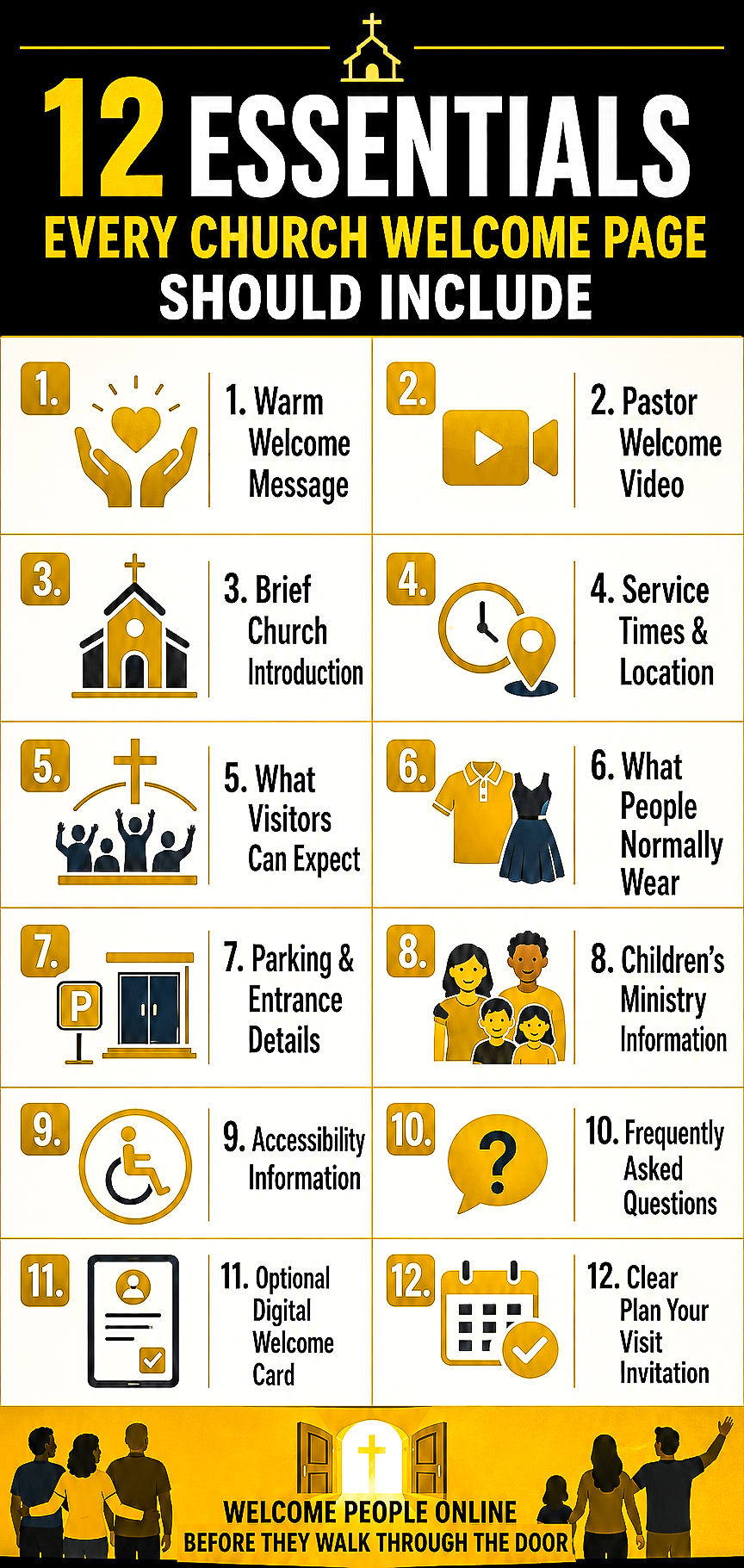
Now, let’s use the checklist below to evaluate your church’s current welcome page one element at a time.
- ☐ Warm and personal welcome message
- ☐ Short pastor or leader welcome video
- ☐ Brief introduction to the church
- ☐ Current service times
- ☐ Complete address and driving directions
- ☐ Explanation of what happens during the service
- ☐ Information about what people normally wear
- ☐ Parking and entrance instructions
- ☐ Children’s ministry and check-in details
- ☐ Accessibility information
- ☐ Frequently asked questions
- ☐ Optional digital welcome card
- ☐ Clear Plan Your Visit invitation
- ☐ Authentic church photographs
- ☐ Mobile-friendly layout
- ☐ Working links, forms, videos, and buttons
Ask someone who has never used the page to test it. Give them a few simple assignments, such as finding the service time, locating children’s information, and planning a visit. Their experience may reveal questions or obstacles your ministry team overlooked.
Turn Your Church Website Into a Welcoming Front Door
Your church may have friendly greeters, a caring congregation, powerful worship, and an encouraging message. However, first-time visitors cannot experience those things if unanswered questions prevent them from walking through the door.
A thoughtful church welcome page helps bridge the distance between discovering your ministry online and feeling comfortable enough to attend.
Hold up a minute! This page is not simply another piece of website content. It is part of your church’s hospitality and outreach ministry.
Every service time you clearly display, every question you answer, and every concern you remove can help someone move one step closer to connecting with a church family.
Welcome people online with the same care, clarity, and compassion you want them to experience when they arrive in person.
Let’s begin by reviewing your current New Here page through the eyes of a first-time visitor. Identify the questions it answers, notice what may be missing, and improve one section at a time.
If you are also improving the rest of your website, explore our guide on what every church website homepage should include .
You can also learn how to create a more personal introduction by reading 25 church welcome message examples for your website .
Is Your Church Website Ready for First-Time Visitors?
Your church website may be the first experience someone has with your ministry. Let’s make sure it clearly welcomes visitors, answers their questions, and gives them a meaningful next step.
Request a Church Website Growth Review and receive practical recommendations for improving your church’s online visitor experience.