
Church marketing has changed.
Years ago, a church could put up a sign, print a flyer, announce an event, and trust that people in the community would hear about it.
But today, people are searching online before they ever visit in person.
They are looking at your website.
They are checking your Google Business Profile.
They are watching videos.
They are scrolling social media.
They are reading reviews.
They are looking for service times, directions, ministries, events, sermons, and answers to real-life questions.
That means churches need more than random announcements.
They need a clear strategy.
Hold up a minute! Church marketing is not about turning ministry into a business.
It is about helping people discover your church, understand your mission, and take a next step toward Jesus.
An effective church marketing strategy helps your church communicate clearly, reach people intentionally, and remove barriers that may keep people from connecting.
This does not mean your church needs to chase every trend or be on every platform.
It means your church needs a plan.
A plan for who you are trying to reach.
A plan for what you want to communicate.
A plan for how your website, social media, Google visibility, email, video, events, and content work together.
In this article, we are going to walk through how to create effective church marketing strategies in 2026.
What Is a Church Marketing Strategy?
A church marketing strategy is a clear plan for how your church communicates its message, reaches people, and helps them take the next step.
It is not just posting on social media.
It is not just making flyers.
It is not just running ads.
It is not just updating the website once every few years.
A church marketing strategy brings everything together.
It helps your church answer questions like:
- Who are we trying to reach?
- What message do we need to communicate?
- What problems are people facing?
- What next step do we want people to take?
- Where are people searching for churches?
- What platforms should we focus on?
- What content should we create?
- How will we measure what is working?
Without a strategy, churches often end up reacting.
Someone remembers to post.
Someone makes a graphic.
Someone sends an email.
Someone updates the website.
Someone announces an event.
Those things can be helpful, but without a clear plan, they may not work together.
A strategy helps your church move from scattered activity to focused outreach.
Why Church Marketing Matters in 2026
Church marketing matters because people are paying attention online before they decide to visit in person.
A first-time guest may already have an opinion about your church before they ever walk through the doors.
They may form that opinion based on your website, social media, Google listing, photos, videos, reviews, sermon clips, or event pages.
That is why clarity matters.
If your church is hard to find online, people may never discover you.
If your website is confusing, people may leave.
If your service times are outdated, people may not trust the information.
If your social media only speaks to current members, new people may feel like outsiders.
If your Google Business Profile is incomplete, people may keep scrolling.
That does not mean your church is not powerful.
It may simply mean your message is not easy to find or understand online.
Church marketing helps bridge that gap.
It helps people see:
- Who your church is
- Where you are located
- When you meet
- What you believe
- What ministries you offer
- How they can get connected
- Why visiting may be worth taking a step of faith
Marketing is not the mission.
But it can support the mission.
The mission is to reach people with the Gospel and help them become fully devoted followers of Jesus Christ.
A strong church marketing strategy helps more people see, understand, and respond to that mission.
Step 1: Know Who Your Church Is Trying to Reach
Before your church creates content, updates the website, or posts on social media, you need to know who you are trying to reach.
This does not mean your church only cares about one kind of person.
The Gospel is for everyone.
But when it comes to communication, clarity matters.
A message that tries to speak to everybody often connects with nobody.
Start by asking:
- Who lives in our community?
- What needs are people facing?
- What questions are people asking?
- What kind of families are nearby?
- Are there young adults, parents, seniors, students, or new residents?
- What ministries does our church already have that serve those needs?
- What type of person is most likely to visit our church for the first time?
For example, a church may want to reach families with children.
Another church may be called to reach young adults.
Another may have a strong recovery ministry.
Another may serve a growing immigrant community.
Another may have a heart for youth and outreach.
When you understand who you are trying to reach, your marketing becomes more focused.
Your website can answer better questions.
Your social media can speak more clearly.
Your events can be promoted with the right language.
Your blog content can serve real needs.
Your Google visibility can be built around the topics people are actually searching for.
Step 2: Clarify Your Church Message
Every church needs a clear message.
Not just a slogan.
A clear message.
People should be able to quickly understand who your church is, what you care about, and how they can take the next step.
Your message should answer basic questions:
- What is your church about?
- What kind of community are you?
- What can someone expect when they visit?
- What is the next step for a new person?
- Why does your church exist?
A confused visitor usually does not take action.
A clear message helps people feel more confident.
For example, instead of only saying:
“Welcome to our church.”
You might say:
“Helping people find hope, grow in faith, and build community through Jesus Christ.”
Instead of only saying:
“Join us Sunday.”
You might say:
“Join us this Sunday in San Francisco for worship, the Word, and a welcoming community for the whole family.”
That kind of message gives people more clarity.
A good church marketing strategy makes the message consistent across your:
- Website
- Social media
- Google Business Profile
- Event promotions
- YouTube descriptions
- Printed materials
- Plan Your Visit page
When people see your church in different places, the message should feel connected.
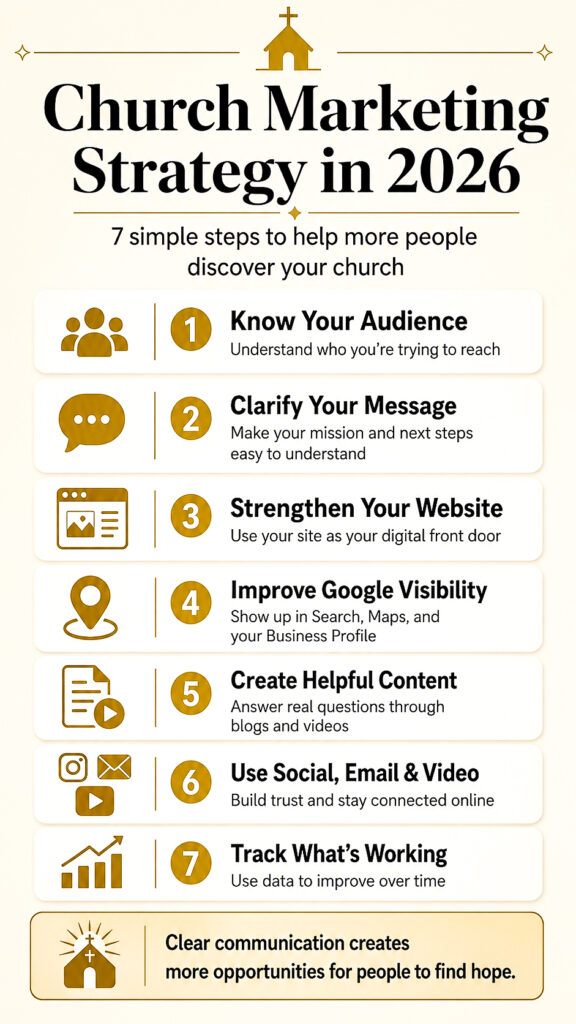
Here is a simple visual breakdown of the seven key steps your church can use to build a stronger marketing strategy in 2026.
Step 3: Make Your Website the Central Hub
Your church website should be the central hub of your marketing strategy.
Social media is helpful.
Google Maps is important.
YouTube is powerful.
Email is useful.
But your website is the place you control.
Your website should bring everything together.
A strong church website should clearly include:
- Service times
- Location
- Contact information
- What to expect
- Plan Your Visit page
- Ministry pages
- Sermons
- Events
- Giving
- Prayer request options
- Clear calls to action
Too many churches treat the website like an online bulletin board.
But your website should be more than that.
It should serve first-time guests, current members, people searching online, and people who are exploring faith.
Your website should help someone answer:
- Is this church near me?
- What time should I come?
- Where do I park?
- What should I wear?
- Is there children’s ministry?
- What does this church believe?
- Can I watch a message first?
- How do I get connected?
If your website answers those questions clearly, it becomes a powerful outreach tool.
This is why church website strategy and church marketing strategy work together.
Your website should not just look good.
It should guide people toward connection.
Step 4: Improve Your Church Visibility on Google
One of the most important church marketing strategies in 2026 is improving your church visibility on Google.
People search before they visit.
They search for churches near them.
They search for service times.
They search for events.
They search for help.
They search for answers.
They search for ministries that serve their family.
That means your church needs to be visible in places like:
- Google Search
- Google Maps
- Google Business Profile
- Blog articles
- YouTube results
- Local search results
Your church can improve Google visibility by making sure your website is clear, your Google Business Profile is updated, your local SEO is strong, and your content answers real questions.
Your Google Business Profile should include accurate:
- Church name
- Address
- Phone number
- Website link
- Service times
- Photos
- Reviews
- Description
- Updates
Your website should include your city, service times, ministries, and helpful content.
Your blog can answer questions people are already asking.
Your videos can help people hear your voice before they visit.
Hold up a minute! If people are already searching for a church in your area, your church should have a chance to show up.
That is not just marketing.
That is digital outreach.
If you want to better understand why SEO matters for churches and how it helps people find your ministry online, watch this short lesson from the course.
Step 5: Use Content to Answer Real Questions
Content is one of the most powerful parts of a church marketing strategy.
But not all content is equal.
Posting announcements is helpful for people who already know your church.
But helpful content can reach people who do not know your church yet.
Your church can create content that answers questions like:
- What should I expect when visiting church for the first time?
- How do I choose a church home?
- Why is prayer important?
- What does baptism mean?
- How can my family get involved in church?
- How do I grow spiritually?
- What does the Bible say about anxiety?
- How can I start reading the Bible?
- What is the purpose of church community?
These topics can become blog articles, short videos, sermon clips, email devotionals, social posts, and teaching resources.
The key is to create content that serves people.
Not just content that fills a calendar.
Every helpful piece of content can become a doorway.
Someone may find your church through a blog article.
Someone may connect through a sermon clip.
Someone may share a post with a friend.
Someone may watch a video before deciding to visit.
Someone may read an article and feel encouraged enough to take the next step.
That is why content matters.
Step 6: Build a Simple Social Media Strategy
Social media can still be helpful for churches, but it works best when it has a purpose.
A church social media strategy should not just be:
“Post something every day.”
That can lead to random content and burnout.
Instead, build your social media around clear content categories.
For example, your church could post:
- Sermon clips
- Scripture encouragement
- Event invitations
- Testimonies
- Volunteer highlights
- Ministry moments
- Behind-the-scenes photos
- Prayer prompts
- First-time guest information
- Community outreach recaps
Each type of post should serve a purpose.
Some posts encourage.
Some invite.
Some build trust.
Some teach.
Some celebrate what God is doing.
Some point people to the website.
Some help current members stay connected.
Some help new people understand the church.
Social media should support the larger strategy.
It should not replace your website.
It should not replace Google visibility.
It should not be the only way your church communicates.
Use social media to create awareness, build connection, and point people toward next steps.
A clear digital outreach strategy can help your church connect your website, social media, content, and next steps together.
Step 7: Use Video to Build Trust
Video is one of the best ways to help people experience your church before they visit.
A person may be nervous about attending a new church.
But if they can watch a sermon, see a testimony, or hear a short welcome video, they may feel more comfortable.
Video helps people hear your tone.
It helps them see your heart.
It helps them understand the culture of the church.
Churches can use video in several ways:
- Sermon clips
- Full messages
- First-time guest welcome videos
- Ministry highlights
- Testimonies
- Event recaps
- Short teaching videos
- Pastor encouragement videos
- YouTube Shorts
- Social media reels
The goal is not just to post video for views.
The goal is to help people connect.
A simple video from the pastor explaining what to expect on Sunday can be powerful.
A testimony from someone whose life was changed can be powerful.
A short clip from a sermon can encourage someone during the week.
A ministry highlight can show people that the church is active and alive.
Video gives people a window into your church.
Use it wisely.
Step 8: Connect Online Marketing to Real Next Steps
One of the biggest mistakes churches make is creating content without a clear next step.
They post an announcement, but do not tell people what to do.
They promote an event, but the link is missing.
They create a video, but do not point people to the website.
They write a blog, but do not invite people to take action.
They share a flyer, but the details are hard to find.
Every church marketing strategy should include clear next steps.
Those next steps may include:
- Plan your visit
- Watch a sermon
- Submit a prayer request
- Register for an event
- Join a small group
- Contact the church
- Sign up for updates
- Visit a ministry page
- Get directions
- Invite a friend
Visibility is important, but visibility alone is not enough.
Once people see your church, they need to know what to do next.
A clear call to action helps people move forward.
If the goal is first-time visits, point people to the Plan Your Visit page.
If the goal is event attendance, point people to registration.
If the goal is prayer, point people to a prayer request form.
If the goal is community, point people to small groups or ministries.
Marketing should lead somewhere.
Step 9: Use Email to Stay Connected
Email is still a valuable tool for church communication.
Social media algorithms change.
People may miss posts.
But email gives your church a direct way to communicate with people who have asked to hear from you.
Your church can use email for:
- Weekly updates
- Event reminders
- Devotional encouragement
- New visitor follow-up
- Ministry updates
- Prayer requests
- Volunteer communication
- Sermon recaps
- Next step invitations
Email works best when it is helpful, clear, and consistent.
Do not only email when you need people to do something.
Use email to encourage, inform, and guide people.
For first-time guests, email can be especially helpful.
After someone fills out a Plan Your Visit form or attends for the first time, your church can send a follow-up message that says:
- Thank you for visiting
- Here is what happens next
- Here are ministries you may be interested in
- Here is how to ask for prayer
- Here is how to connect with someone
That kind of communication helps people feel seen and cared for.
Step 10: Track What Is Working
A church marketing strategy should be measured.
Not because ministry is about numbers.
But because numbers can reveal clues.
Google Search Console can show what people are searching for before they find your website.
Google Analytics 4 can show what people do after they arrive.
Your Google Business Profile can show local actions like website clicks, direction requests, and phone calls.
YouTube Analytics can show which videos people are watching.
Social media insights can show what content people are engaging with.
Email reports can show what people open and click.
These tools help your church stop guessing.
If you want a simple breakdown of the best tools to track your website, start with these church website analytics tools.
You can begin to see:
- Which pages are getting attention
- Which topics people care about
- Which videos are connecting
- Which events are getting interest
- Which pages need improvement
- Which calls to action are working
- Which content should be created next
The goal is not to obsess over data.
The goal is to make better ministry decisions.
If a blog article is getting impressions but no clicks, renovate it.
If a page gets traffic but no next steps, improve the call to action.
If a video gets strong engagement, create more content around that topic.
If your Google Business Profile gets direction requests, keep it updated and active.
Google leaves clues.
Your job is to pay attention and respond with wisdom.
Step 11: Create a Monthly Church Marketing Rhythm
A strategy only works if it becomes a rhythm.
Your church does not need to do everything every day.
A simple monthly rhythm can help your team stay consistent.
Each month, your church can:
- Review website updates
- Check Google Search Console
- Review Google Business Profile
- Plan social media content
- Choose one blog or article topic
- Create sermon clips
- Promote upcoming events
- Send email updates
- Review analytics
- Improve one important page
This keeps your church moving forward without overwhelming the team.
You do not need a massive marketing department.
You need clear priorities.
Start small.
Stay consistent.
Improve over time.
A church that makes small improvements every month can build a strong digital presence over the course of a year.
Common Church Marketing Mistakes to Avoid
As your church builds a marketing strategy, here are some common mistakes to avoid.
Mistake 1: Only Talking to Current Members
Your communication should serve current members, but it should also help new people understand your church.
Use clear language.
Explain next steps.
Answer visitor questions.
Avoid only using internal terms that outsiders may not understand.
Mistake 2: Depending Only on Social Media
Social media is helpful, but it should not be your whole strategy.
Your church also needs a strong website, Google visibility, email list, video presence, and clear next steps.
Mistake 3: Posting Without a Purpose
Do not just post because the calendar says to post.
Every piece of content should have a reason.
Encourage, invite, teach, inform, build trust, or guide people to a next step.
Mistake 4: Ignoring Google
Many churches focus on social media but forget that people are actively searching on Google.
Google visibility matters because people use it when they are looking for a church, directions, service times, ministries, or answers.
Mistake 5: Not Tracking Results
If your church never looks at the data, you may miss what is working.
You may also miss what needs to be improved.
Use data as a tool for stewardship.
Frequently Asked Questions About Church Marketing Strategies in 2026
How do I create effective church marketing strategies in 2026?
To create effective church marketing strategies in 2026, start by identifying who your church is trying to reach, clarifying your message, improving your website, strengthening your Google visibility, creating helpful content, using social media with purpose, and tracking what is working.
The key is to make sure every part of your communication works together.
Your website, Google Business Profile, social media, email, videos, events, and content should all point people toward clear next steps.
An effective strategy is not just about posting more.
It is about communicating more clearly and helping people connect with your church.
What are the best church marketing strategies in 2026?
Some of the best church marketing strategies in 2026 include improving your church website, optimizing your Google Business Profile, using church SEO, creating helpful blog content, posting purposeful social media content, using video, building an email list, and tracking performance with tools like Google Search Console and Google Analytics 4.
The best strategy is not always the most complicated one.
For many churches, the best place to start is with the basics:
Make your website clear.
Make your church easy to find on Google.
Make your next steps simple.
Then build from there.
Why is church marketing important in 2026?
Church marketing is important in 2026 because many people search online before they ever visit a church in person.
They may look at your website, Google Business Profile, reviews, photos, videos, social media, and sermon clips before deciding whether to attend.
If your church is hard to find or hard to understand online, people may move on before they ever experience the ministry in person.
Church marketing helps remove those barriers.
It helps people discover your church, understand your mission, and take a next step toward Jesus.
When should churches implement marketing strategies in 2026?
Churches should implement marketing strategies before they urgently need them.
A marketing strategy works best when it is built consistently over time.
Do not wait until a major event, outreach, or special service to start thinking about communication.
Start now by reviewing your website, Google Business Profile, social media, email list, content, and next steps.
Then create a simple monthly rhythm for improving one area at a time.
Church marketing becomes more effective when it becomes part of your regular ministry planning, not something you only do at the last minute.
How do I use social media for church marketing in 2026?
You can use social media for church marketing by creating content that encourages people, builds trust, shares your church culture, promotes events, and points people to clear next steps.
Social media posts can include sermon clips, Scripture encouragement, testimonies, ministry highlights, event invitations, prayer prompts, volunteer stories, and first-time guest information.
The goal is not just to post more.
The goal is to post with purpose.
Social media should support your larger church marketing strategy by pointing people back to your website, Plan Your Visit page, event pages, sermon content, and next steps.
What is the role of digital marketing in churches in 2026?
Digital marketing helps churches reach people online through websites, Google Search, Google Maps, social media, email, video, blog content, and digital outreach.
In 2026, digital marketing plays an important role because many people begin their church search online.
They may search for a church near them, look for service times, watch a sermon, read about ministries, or explore what your church believes before they visit.
Digital marketing does not replace personal ministry.
It supports it.
It helps your church become easier to find, easier to understand, and easier to connect with.
Why does my church need a marketing strategy in 2026?
Your church needs a marketing strategy in 2026 because random communication often creates random results.
A strategy helps your church communicate with clarity, reach people intentionally, and guide them toward meaningful next steps.
Without a strategy, churches may post inconsistently, miss opportunities on Google, neglect their website, overlook email follow-up, or create content that does not lead anywhere.
A clear marketing strategy helps your church stay focused.
It helps your team know what to say, where to say it, who you are trying to reach, and what step you want people to take next.
Where can I find church marketing resources in 2026?
You can find church marketing resources by studying topics such as church SEO, digital outreach, Google Business Profile optimization, Google Search Console, Google Analytics 4, church website strategy, social media content, email follow-up, and video marketing.
A good place to start is by reviewing your current church website and asking:
Can people find us?
Can people understand us?
Can people take the next step?
From there, use tools like Google Search Console, Google Analytics 4, and your Google Business Profile to see what is working and what needs to improve.
The best church marketing resources are the ones that help your church communicate clearly, serve people well, and point people toward Jesus.
Final Thoughts: Church Marketing Is About Reaching People
Church marketing is not about hype.
It is not about pretending to be something you are not.
It is not about chasing every trend.
At its best, church marketing is about communication, clarity, and connection.
It helps people find your church.
It helps people understand your mission.
It helps people know what step to take next.
It helps your church serve people before they ever walk through the doors.
Your church may have a powerful message, a loving community, and ministries that can change lives.
But people need to know you are there.
They need to be able to find you.
They need to understand how to connect.
That is why an effective church marketing strategy matters.
Start with one step.
Clarify your message.
Improve your website.
Update your Google Business Profile.
Create helpful content.
Use social media with purpose.
Track what is working.
Keep improving.
Because when your church communicates clearly and shows up where people are searching, you create more opportunities for people to discover your ministry, visit your church, and take their next step toward Jesus.