
Many churches know their website needs work.
The design may feel outdated.
The service times may be hard to find.
The website may not look good on mobile.
The pages may not explain what visitors should expect.
The church may be posting on social media, creating flyers, sharing sermon clips, and inviting people to events, but when someone finally visits the website, they still may not know what step to take next.
That is why many pastors and church leaders start searching for church website design services, website design services for churches, church website design companies, or the best church website design options before they hire help.
And that can be a wise step.
But before your church hires someone to design or redesign your website, it is important to understand what your church website actually needs.
Because a church website should do more than look nice.
It should help people find your church, understand your ministry, and take a clear next step.
Your church website is one of the most important digital tools your ministry has. It can serve first-time visitors, encourage members, support outreach, improve Google visibility, and help people connect with your church before they ever walk through the doors.
What Are Church Website Design Services?
Church website design services are services that help churches create, redesign, or improve their website.
These services may include:
- Website design
- Website redesign
- Mobile optimization
- Page layout
- Copywriting
- Search engine optimization
- Website hosting
- Website maintenance
- Online giving setup
- Sermon or media pages
- Event pages
- Contact forms
- Plan your visit pages
- Google Analytics setup
- Google Search Console setup
Some church website design services focus mainly on how the website looks.
Others focus on strategy, visibility, and visitor next steps.
The best church website design services should help your church do both.
Your website should look professional, but it should also be useful, clear, easy to navigate, and built with people in mind.
Why Your Church Website Matters
Your website matters because people often visit your church online before they visit in person.
They may hear about your church from a friend.
They may see a sermon clip.
They may find your church on Google.
They may see your church on social media.
They may search for churches near them.
But before they show up on Sunday, many people will check your website.
They want to know:
Where is the church located?
What time is service?
What should I wear?
Is there something for my kids?
What does the church believe?
What is the atmosphere like?
Can I watch a sermon first?
How do I contact someone?
Can I plan a visit?
Is this church a place where I could belong?
That means your website is not just a digital brochure.
It is part of your church’s first impression.
A clear website can reduce confusion, build trust, and help visitors feel more comfortable taking the next step.
Why Is a Professional Church Website Important?
A professional church website is important because it helps your church communicate with clarity.
People are used to finding information quickly. If your website feels confusing, outdated, or difficult to use, visitors may leave before they ever understand your church.
That does not mean your church website has to be fancy.
It means it needs to be clear.
A professional church website should help people quickly understand:
- Who your church is
- Where your church meets
- When your church gathers
- What visitors can expect
- What ministries are available
- How to watch a sermon
- How to contact the church
- How to take the next step
The goal is not to impress people with design.
The goal is to serve people with clarity.
The Challenge With a Good-Looking Website
A good-looking website is helpful.
But good design by itself is not enough.
A church can have a beautiful website that still does not help people take action.
The site may look modern, but if visitors cannot find service times, location, ministries, sermons, or next steps, the website is not serving them well.
Hold up a minute.
Your church website does not just need to be attractive.
It needs to be clear.
It needs to answer real questions.
It needs to guide people.
It needs to work on mobile.
It needs to help your church show up on Google.
It needs to make the next step obvious.
That is why church website design should include strategy, not just style.
Best Church Website Design: What Makes a Church Website Effective?
When pastors search for the best church website design or top church website examples, they are often trying to understand what a strong church website should look like.
But the best church website design is not just about colors, fonts, photos, or layout.
The best church website design helps people take action.
An effective church website should be:
- Clear
- Mobile-friendly
- Easy to navigate
- Helpful for first-time visitors
- Connected to Google visibility
- Built around next steps
- Easy for the church team to update
- Focused on people, not just design
A strong church website should help someone quickly answer:
Is this church near me?
When do they meet?
What can I expect?
Is there something for my family?
Can I watch a message?
How do I connect?
What is my next step?
That is what makes a church website effective.
Not just beautiful design.
Clear communication.
What Every Church Website Should Include
Before your church hires a website designer or church website design company, make sure you know what your website needs to include.
A strong church website should make it easy for visitors to find the most important information quickly.
Here are the key pieces every church website should have.
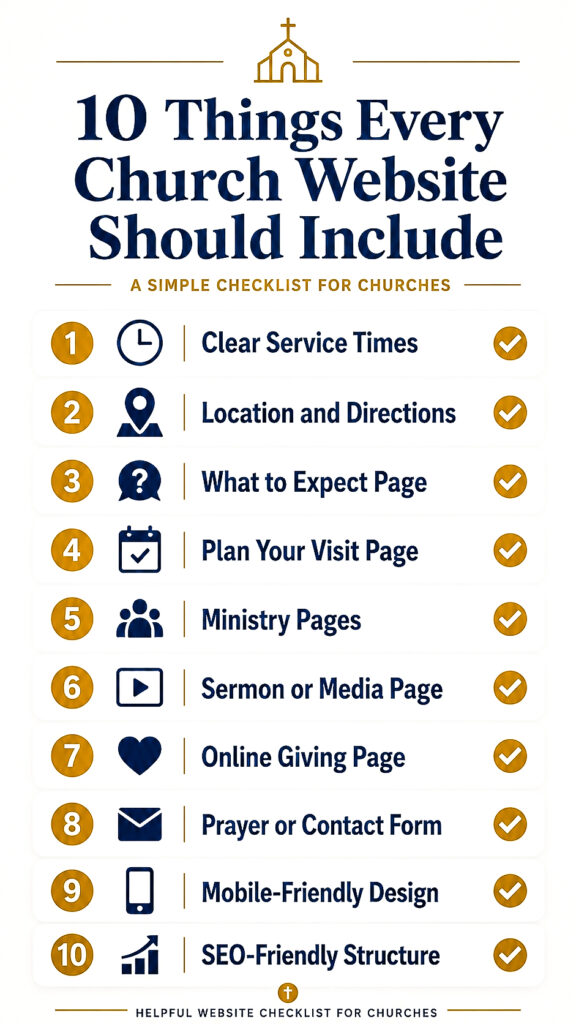
1. Clear Service Times
Your service times should be easy to find.
Do not hide them at the bottom of the page or only mention them on a flyer.
A first-time visitor should be able to land on your homepage and quickly know when your church meets.
Your service times should usually appear on:
- The homepage
- The footer
- The visit page
- The contact page
- The Google Business Profile
- Event or service-related pages
People should not have to search hard to find out when to come.
2. Location and Directions
Your church location should also be clear.
Include your full address, city, state, and a map if possible.
If parking can be confusing, explain where people should park.
If your church meets in a school, rented facility, community center, or shared building, make that clear.
A strong location section can include:
- Church address
- Google Map
- Parking instructions
- Entrance information
- Nearby landmarks
- Accessibility details
- Contact information
This is especially important for local SEO because Google uses location information to understand where your church is and who it may be relevant for.
3. A “What to Expect” Page
A “What to Expect” page is one of the most valuable pages a church website can have.
First-time visitors often have questions before they attend.
They may wonder what the service is like, how long it lasts, what to wear, what happens with kids, and whether they will feel welcome.
A good “What to Expect” page can answer questions like:
What time should I arrive?
How long is the service?
What is worship like?
Is there children’s ministry?
What should I wear?
Will someone greet me?
Can I come if I have never been to church before?
This page helps reduce hesitation.
It gives people confidence before they visit.
4. A Plan Your Visit Page
A “Plan Your Visit” page gives people a clear next step.
This page should be simple, welcoming, and easy to use.
It can include:
- Service times
- Location
- What to expect
- Children’s ministry information
- A short form
- Contact information
- Parking details
- A welcome message
The goal is to help someone go from interested to ready.
A good church website design service should understand how important this page is.
It is one of the clearest pathways from online search to in-person visit.
5. Ministry Pages
Your website should explain the ministries your church offers.
This may include:
- Children’s ministry
- Youth ministry
- Young adults
- Men’s ministry
- Women’s ministry
- Small groups
- Recovery ministry
- Outreach
- Prayer ministry
- Missions
- Discipleship
Each ministry page should answer simple questions:
Who is this ministry for?
When does it meet?
What can someone expect?
How can someone get involved?
Who should they contact?
Ministry pages help people see where they can connect.
They also give Google more context about what your church offers.
6. Sermon or Media Page
A sermon or media page helps people experience your church before attending.
Someone may watch a sermon before deciding to visit.
A sermon page can also serve your current members by making it easy to catch up on messages.
Your sermon or media page can include:
- Recent sermons
- YouTube embeds
- Audio messages
- Series descriptions
- Speaker information
- Message notes
- Related blog posts
- Calls to action
This page does not have to be complicated.
It just needs to be clear, organized, and updated consistently.
7. Online Giving Page
Your giving page should be easy to find and easy to understand.
For members and supporters, online giving is a common next step.
A strong giving page should explain:
- Why giving matters
- How giving supports the mission
- Where to give
- What options are available
- Whether giving is secure
- How to get help if needed
A giving page should not feel confusing or hidden.
It should be simple, trustworthy, and connected to the mission of the church.
8. Prayer Request or Contact Form
People often visit church websites when they need help, prayer, or connection.
Your website should make it easy for them to reach out.
A prayer request or contact form can help people take a meaningful next step.
The form should be simple.
Do not ask for too much information.
Ask for what you need to respond well.
A basic form may include:
- Name
- Email or phone
- Prayer request
- Question or message
- Permission to follow up
Your website should make it easy for people to connect with a real person.
9. Strong Mobile Design
Most people will visit your church website from a phone.
That means mobile design is not optional.
Your website should be easy to read and use on a mobile screen.
A mobile-friendly church website should have:
- Clear buttons
- Easy navigation
- Fast loading pages
- Readable text
- Clickable phone numbers
- Simple forms
- Visible service times
- Easy access to directions
- Clear next steps
If your website looks good on desktop but feels difficult on mobile, visitors may leave before they ever learn about your church.
10. SEO-Friendly Structure
Church website design and church website SEO should work together.
A website may look beautiful, but if Google cannot understand it, fewer people may find it.
An SEO-friendly church website should include:
- Clear page titles
- Helpful headings
- Local keywords
- Fast loading pages
- Mobile-friendly design
- Internal links
- Optimized images
- Clear ministry pages
- Location information
- Helpful content
- Google Search Console setup
- Google Analytics 4 setup
Your website should be built for people first, but it should also help search engines understand what your church offers and where your church is located.
Church Website Design and Google Visibility
One of the biggest reasons church website design matters is Google visibility.
People are searching online before they visit.
They search for churches near them.
They search for Sunday service times.
They search for children’s ministry.
They search for youth ministry.
They search for prayer.
They search for churches in their city.
If your website is unclear, outdated, or poorly structured, your church may miss opportunities to show up when people are searching.
A good church website design service should understand the connection between your website and Google.
Your website should help your church show up for searches related to:
- Your church name
- Your city
- Churches near me
- Christian church in your city
- Youth ministry near me
- Children’s ministry near me
- Prayer requests
- Church events
- Church service times
This does not happen by accident.
It requires strategy.
If you want to understand why your church website needs more than good design, watch this short lesson on why SEO matters for churches.
Church Website Design vs. Church Website SEO
Church website design and church website SEO are connected, but they are not the same thing.
Website design focuses on how the website looks and functions.
Church website SEO focuses on helping the website show up in search results.
Design asks:
Does the website look good?
Is it easy to use?
Is the layout clear?
Is the branding consistent?
Does it work on mobile?
SEO asks:
Can Google understand the website?
Are the pages structured well?
Are the headings clear?
Are the right keywords included?
Are images optimized?
Are pages internally linked?
Is the website connected to Google Search Console?
Does the site answer questions people are searching for?
Your church needs both.
A good-looking website that nobody finds is limited.
A website that gets traffic but confuses visitors is also limited.
The goal is to build a website that is both visible and helpful.
How to Choose a Church Website Design Service
Choosing a church website design service should not only be about price or portfolio.
It should be about fit.
The right website design service should understand your church’s mission, your visitors, your community, your ministries, and your goals.
Before you choose a church website design service, ask:
Do they understand churches?
Do they understand first-time visitors?
Do they know how to build mobile-friendly websites?
Do they understand SEO?
Can they help with Google visibility?
Can they create clear next steps?
Will they help organize the website around ministry needs?
Can your team update the website after launch?
Will they explain things in simple terms?
A good church website design service should not just build a site for your church.
They should help your church communicate better.
Questions to Ask Before Hiring a Church Website Designer
Before hiring someone for church website design services, ask the right questions.
Here are some helpful questions your church can ask:
Do you have experience building church websites?
Do you understand ministry communication?
Will the website be mobile-friendly?
Will the website be SEO-friendly?
Will you help us with service times, location, and visitor next steps?
Will you help us create a “Plan Your Visit” page?
Will you help us organize our ministry pages?
Will you optimize images?
Will you connect the site to Google Search Console?
Will you connect the site to Google Analytics 4?
Will we be able to update the website ourselves?
Do you offer training for our team?
What happens after the website is launched?
How will we know if the website is working?
A good website designer should be able to explain the process clearly.
If everything feels confusing, slow down and ask more questions.
Your church should understand what you are paying for.
Red Flags to Watch For
Not every website designer is the right fit for a church.
Here are some red flags to watch for:
They only care about how the site looks.
They do not talk about visitors.
They do not ask about your mission.
They do not mention mobile design.
They do not understand local SEO.
They do not talk about Google visibility.
They do not discuss clear next steps.
They make the site hard for your team to update.
They do not explain what happens after launch.
They use confusing language without helping your team understand.
They build pages that look nice but do not answer visitor questions.
Your website should not just impress people.
It should help people.
Should Your Church Hire Help or Improve the Website In-House?
Some churches should hire help.
Other churches may be able to improve their website in-house with the right training and direction.
Hiring help may be wise if:
- Your website is outdated
- Your team is overwhelmed
- Your church needs a full redesign
- You need a professional look
- Your site is hard to update
- Your pages are confusing
- Your church is not showing up on Google
- You need help with strategy
Improving the website in-house may be wise if:
- Your team has time
- You already have a website platform
- You have volunteers who can help
- You want to save money
- You want to learn SEO
- You want to make small improvements first
- You need a better plan before hiring
Sometimes the best move is to learn first, then hire later.
When your church understands what a healthy website needs, you can make better decisions and avoid paying for things that do not help your ministry grow.
What a Strong Church Website Strategy Should Include
A strong church website strategy should include more than design.
It should bring together your message, visitor journey, Google visibility, content, and next steps.
Your church website strategy should include:
- Clear homepage messaging
- Service times
- Location and directions
- What to expect page
- Plan your visit page
- Ministry pages
- Sermons or media
- Giving page
- Contact or prayer form
- Mobile-friendly design
- Local SEO
- Blog content
- Internal links
- Google Search Console
- Google Analytics 4
- Clear calls to action
When these pieces work together, your website becomes more than a place people visit online.
It becomes a digital front door.
Frequently Asked Questions About Church Website Design Services
How do I create an effective church website?
You create an effective church website by making the site clear, mobile-friendly, easy to navigate, and focused on visitor next steps.
Start with the most important information people need: service times, location, what to expect, ministries, sermons, contact information, and a clear way to plan a visit.
An effective church website should help people find your church, understand your mission, and know what step to take next.
How do I choose a church website design service?
Choose a church website design service by looking for someone who understands ministry, visitor communication, mobile design, SEO, Google visibility, and clear next steps.
Do not only look at how beautiful the websites are.
Ask whether the designer can help your church build a website that is clear, searchable, easy to update, and helpful for first-time visitors.
Why is a professional church website important?
A professional church website is important because many people will visit your church online before they visit in person.
Your website helps people find service times, location, ministries, sermons, events, and next steps.
It also helps build trust, answer visitor questions, and improve your church’s online visibility.
What are the benefits of church website design services?
Church website design services can help your church create a clearer, more professional, more mobile-friendly, and more visitor-focused website.
Good website design services can also help with SEO, Google visibility, online giving, sermon pages, ministry pages, contact forms, and visitor next steps.
The benefit is not just a better-looking website.
The benefit is a website that serves people better.
How do I optimize my church website for mobile?
You optimize your church website for mobile by making sure the text is easy to read, buttons are easy to tap, pages load quickly, menus are simple, forms are short, and service times, directions, and next steps are easy to find.
Since many people visit church websites from their phones, mobile design should be a priority, not an afterthought.
What is a church website design service?
A church website design service helps churches create, redesign, or improve their websites.
This may include design, page structure, mobile optimization, SEO, copywriting, online giving setup, sermon pages, event pages, forms, and ongoing maintenance.
The best services help your church create a website that is clear, useful, and easy for people to navigate.
Where can I find church website design services?
You can find church website design services by searching online, asking other churches for recommendations, reviewing church website design portfolios, and comparing providers who understand ministry, SEO, mobile design, and visitor next steps.
Before hiring, make sure the service provider understands the needs of churches, not just general business websites.
Should I hire a designer for my church website?
You should consider hiring a designer for your church website if your current site is outdated, confusing, hard to update, not mobile-friendly, or not helping people take clear next steps.
If your church has someone with the time and skill to improve the site, you may be able to start in-house.
But if the website needs a full redesign, strategy, SEO, or professional structure, hiring help may be a wise investment.
What should a church website include?
A church website should include service times, location, directions, a what to expect page, a plan your visit page, ministry pages, sermons, events, giving, contact information, prayer requests, mobile-friendly design, and clear next steps.
It should also be structured in a way that helps Google understand the church and its location.
How can church website design help with SEO?
Church website design can help with SEO by creating clear page structure, helpful headings, mobile-friendly pages, optimized images, internal links, fast loading pages, and location-based content.
Good design helps people use the site.
Good SEO helps people find the site.
Your church needs both.
Final Thoughts: Your Website Is a Digital Front Door
Your church website is one of the most important tools your ministry has for reaching people online.
It helps people discover your church.
It helps visitors understand what to expect.
It helps families find ministries.
It helps people watch sermons.
It helps people ask questions.
It helps people take next steps.
It helps your church show up on Google.
That is why church website design services should be about more than making the site look modern.
The goal is to build a website that is clear, helpful, findable, and connected to your mission.
Before your church hires help, take time to understand what your website really needs.
Know your message.
Know your audience.
Know your next steps.
Know what pages matter.
Know how people are searching.
Know how you will measure what is working.
A strong church website does not just sit online.
It serves people.
It creates clarity.
It supports outreach.
It helps your church become easier to find and easier to connect with.
And when your church website becomes clearer, more helpful, and more visible, you create more opportunities for people to take their next step.